Chapel St. Walburga

According to legend, the construction of Chapel St. Walburga was financed with a found treasure...

With about 600 inhabitants, the place Hoxel, first mentioned in 1281, is the fifth largest district of the unified municipality of Morbach founded in 1975. Together with Morscheid-Riedenburg and Wolzburg, it forms the so-called "Balkan".

Four chapels in neighboring villages, which now belong to Morbach, were built in 1770: those of Odert, Riedenburg (replaced after a lightning strike in 1898 by a new building), Wolzburg, and of course St. Walburga in Hoxel. Only in 2022 could the postponed joint 250th anniversary be made up for with a chapel hike from Odert over Hoxel and Wolzburg to Riedenburg.

“According to legend, the money for these buildings came from a treasure that the then-serving pastor J. Anton Klee found in a house in Odert that had been bequeathed to the church. An officer is said to have buried the treasure there during the Thirty Years' War.” (see the very informative homepage www.balkan.city).

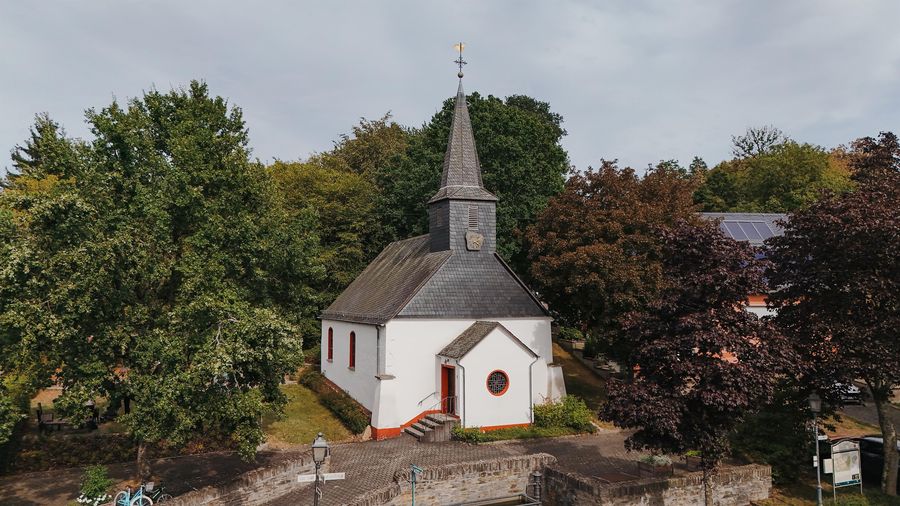
St. Walburga is very picturesque, located in the center of the village at the road junction to Morscheid-Riedenburg; the fountain right in front of the chapel and a playground right next to it emphasize the small village center, which is maintained by the citizens. The chapel is, similar to those of Odert and Wolzburg, a small hall building with a curved wooden ceiling, a bell tower, flat-arched windows, and a three-sided choir closure.

The most remarkable piece of equipment is the Baroque altar from the beginning of the 17th century with twisted columns adorned with vine leaves, which possibly comes from a church in Trier. Two smaller side figures of Saint Catherine and Saint Barbara date from the end of the 17th century; in the central field of the altar, a larger figure of the church patroness Walburga from the mid-17th century was positioned in 1960 during a renovation, replacing a lost painting.

Saint Walburga, originally from Wessex in southern England, lived in the 8th century. Her brothers Wunibald and Willibald followed the call of their uncle Boniface and evangelized in southern Germany. Walburga did the same a few years later and led a significant double monastery in Heidenheim.

From the reliquary of the saint in the Abbey of St. Walburg in Eichstätt, a liquid (“Walburgis oil”) is said to regularly seep out, which is why she is often depicted, as in Hoxel, with a small oil flask standing on a book.

Also noteworthy is a figure of Saint Apollonia placed to the right of the altar, presumably also from the 17th century.

The pretty filial chapel St. Walburga belonged to Berglicht in the Middle Ages, from 1569 to the newly founded parish of Morscheid-Walholz, and later to the parish of Morscheid. On January 1, 2022, it merged into the newly founded parish of Vierzehnheilige Morbach. On April 1, 2025, Michael Meiser was introduced as pastor.
Categories

Baroque Chapel Sights
Contact details

Email: touristinfo@morbach.de Phone: (0049)6533 71-117 Website: http://morbach.de

Opening hours
Monday: 00:00 - 23:59
Tuesday: 00:00 - 23:59
Wednesday: 00:00 - 23:59
Thursday: 00:00 - 23:59
Friday: 00:00 - 23:59
Saturday: 00:00 - 23:59
Sunday: 00:00 - 23:59
Address

Bahnhofstraße 19
54497 Morbach (DE)

Coordinates

Lat: 49.777367
Long: 7.098916

More information

With about 600 inhabitants, the place Hoxel, first mentioned in 1281, is the fifth largest district of the unified municipality of Morbach founded in 1975. Together with Morscheid-Riedenburg and Wolzburg, it forms the so-called "Balkan".

Four chapels in neighboring villages, which now belong to Morbach, were built in 1770: those of Odert, Riedenburg (replaced after a lightning strike in 1898 by a new building), Wolzburg, and St. Walburga in Hoxel. Only in 2022 could the postponed joint 250th anniversary be celebrated with a chapel hike from Odert through Hoxel and Wolzburg to Riedenburg.

“According to legend, the money for these buildings came from a treasure that the then-serving pastor J. Anton Klee found in a house in Odert that had been bequeathed to the church. An officer is said to have buried the treasure there during the Thirty Years' War.” (see the very informative homepage www.balkan.city).

St. Walburga is very picturesque in the center of the village at the road junction to Morscheid-Riedenburg; the fountain right in front of the chapel and a playground right next to it emphasize the small village center, which is maintained by the citizens. The chapel is, similar to those of Odert and Wolzburg, a small hall building with a curved wooden ceiling, a bell tower, flat-arched windows, and a three-sided choir closure.

The most noteworthy piece of equipment is the Baroque altar from the beginning of the 17th century with twisted columns adorned with vine leaves, which possibly comes from a church in Trier. Two smaller side figures of Saint Catherine and Saint Barbara date from the end of the 17th century; in the central field of the altar, a larger figure of the church patroness Walburga from the mid-17th century was positioned during a renovation in 1960 to replace a lost painting.

Saint Walburga, originating from Wessex in southern England, lived in the 8th century. Her brothers Wunibald and Willibald followed the call of their uncle Boniface and evangelized in southern Germany. Walburga did the same a few years later and led a significant double monastery in Heidenheim.

From the reliquary of the saint in the Abbey of St. Walburg in Eichstätt, a liquid (“Walburgis oil”) is said to regularly ooze out, which is why she is often depicted, as in Hoxel, with a small oil flask standing on a book.

Also noteworthy is a figure of Saint Apollonia placed to the right of the altar, presumably also from the 17th century.

The pretty filial chapel of St. Walburga belonged to Berglicht in the Middle Ages, from 1569 to the newly founded parish of Morscheid-Walholz, and later to the parish of Morscheid. On January 1, 2022, it merged into the newly founded parish of Vierzehnheilige Morbach. Michael Meiser was introduced as pastor on April 1, 2025.

According to legend, the construction of the chapel St. Walburga in Morbach-Hoxel was financed with a found treasure.