


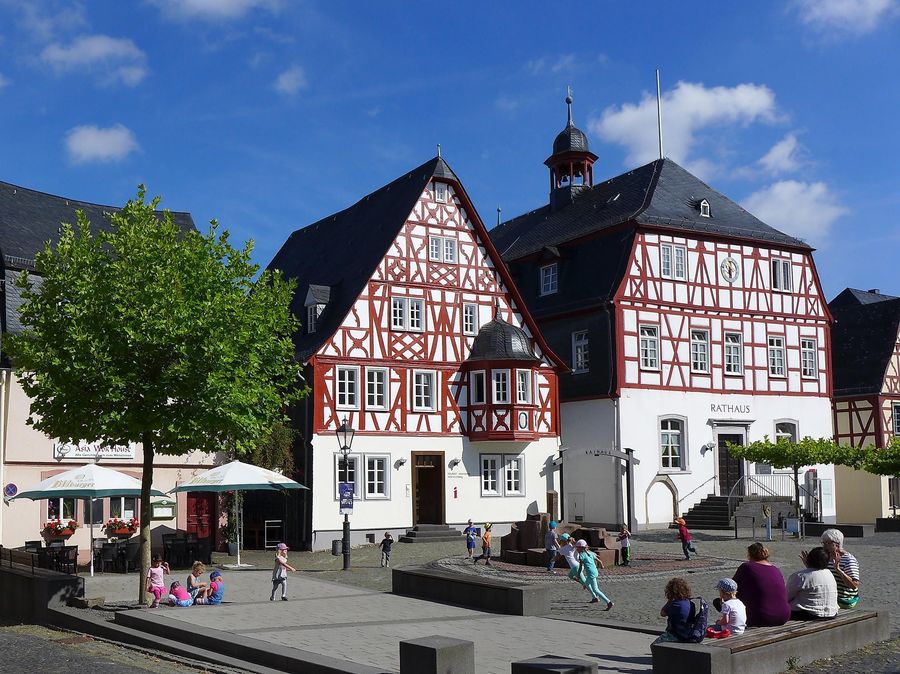
The market square has been the spatial center of the town since the late Middle Ages. The historical houses in its vicinity deserve special attention. They date back to the 17th and 18th centuries. The ensemble of this rectangular square layout is considered a significant example of baroque square design in rural areas. A developed yet thoughtful planning over extended periods is evident in the arrangement of the houses around the market square. The majority of the buildings are half-timbered houses. The southern side has changed significantly due to renovations and new constructions in recent decades.
The House Marktplatz 7 was built around 1700 and was exemplary restored in the second half of the 20th century, maintaining the old entrance with a bronze lion's head as a door knocker.
The “House Weber” (Marktplatz 6), built in the first half of the 17th century, stands out due to its rich symmetrical half-timbering and the five-sided bay window with a curved roof added in 1698. Today, it houses the tourist information center.
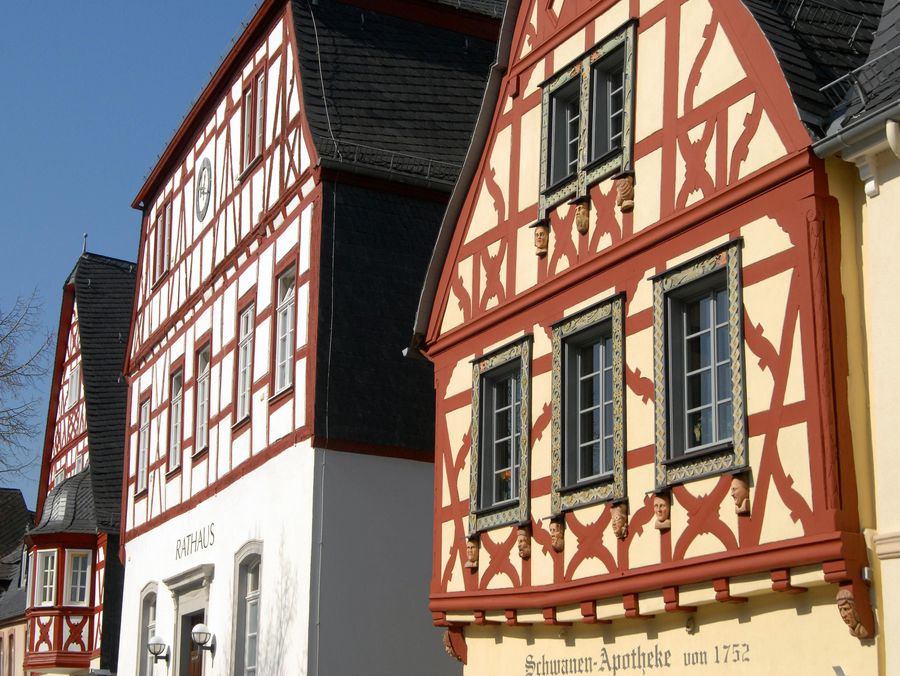
The town hall, built in 1746 using parts of the predecessor building from the 17th century, dominates the square with its size and strict architecture. A comprehensive facade renovation took place in 1983, during which the original half-timbering was uncovered. The old town hall clock from 1896 is located in the attic.
The former “Schwanen-Apotheke” and today's provincial office is an example of half-timbered houses from the 17th century. The first verifiable privilege for a pharmacy in Kirchberg was granted in 1752 by Ludwig Georg, Margrave of Baden. Thus, the Kirchberg pharmacy was the oldest in the Hunsrück until 2020.
Directly next to the building is the former Gasthaus Jägerhof, which was built in the neoclassical architectural style. Despite different construction methods and stylistic elements, the two houses form a harmonious ensemble.
On the southern side of the market square, the former Badische Försterei (Hauptstraße 17) was built in 1753. A significant building from the Baden era in immediate proximity was the Badische Gendarmerie (Hauptstraße 19). The building was constructed after 1750.
In the passage of the left arcade, there is a sandstone figure of St. John Nepomuk. It is a quality work attributed to the Mainz court sculptor Burkhard Zamels († before 1757).
Another noteworthy building is the “Eiscafé Torino”. It dates from the second half of the 17th century. The beautiful front door is from around 1780. According to tradition, Napoleon is said to have sat on the old stone bench in front of the house when he passed through Kirchberg in 1813.
The archway between the market square and Kirchplatz commemorates the 700th anniversary of the town of Kirchberg in 1949. The arch was originally set up as a theater backdrop and was renewed in 1976.
Historical Market Square
Kirchberg Market Square join us for a small tour around our historical...
Categories
Contact details
Email: touristik@kirchberg-hunsrueck.de Phone: (0049)6763 910144 Website: https://www.kirchberg-hunsrueck.de/Kartenvorverkauf.html
Opening hours
Monday: 00:00 - 23:59Tuesday: 00:00 - 23:59
Wednesday: 00:00 - 23:59
Thursday: 00:00 - 23:59
Friday: 00:00 - 23:59
Saturday: 00:00 - 23:59
Sunday: 00:00 - 23:59
Address
Marktplatz 5
55481
Kirchberg(Hunsrück)
(DE)
Coordinates
Lat: 49.942780
Long: 7.406250
More information
join us for a small tour around our historic market square:
The starting point is the fountain in front of the tourist information center, which was built in 1988 over an old, nearly 20-meter-deep well shaft. The structure itself and the paving around the fountain indicate the core of the town of Kirchberg with the former moat.
The market square has been the spatial center of the town since the late Middle Ages. The historic houses in its vicinity deserve special attention. They date back to the 17th and 18th centuries. The ensemble of this rectangular square layout is considered a significant example of baroque square design in rural areas. A developed yet thoughtful planning over longer periods is evident in the arrangement of the houses in the market square area. The majority of the buildings are half-timbered houses. The south side has changed significantly due to renovations and new constructions in recent decades.
The House Market Square 7 was built around 1700 and was exemplary restored in the second half of the 20th century while retaining the old entrance with a bronze lion's head as a door knocker.
The “House Weber” (Market Square 6), built in the first half of the 17th century, stands out with its rich symmetrical half-timbering and the five-sided bay window with a curved roof added in 1698. Today, the tourist information center is located here.
The town hall, built in 1746 using parts of the predecessor building from the 17th century, dominates the square with its size and strict architecture. A comprehensive facade renovation took place in 1983, during which the original half-timbering was uncovered. In the attic, there is the old town hall clock from 1896.
The former “Schwanen-Apotheke” and today's provincial office is an example of half-timbered houses from the 17th century. The first verifiable privilege for a pharmacy in Kirchberg was granted in 1752 by Ludwig Georg, Margrave of Baden. Thus, the Kirchberg pharmacy was the oldest in the Hunsrück until 2020.
Directly next to the building is the former Gasthaus Jägerhof, which was built in the neoclassical architectural style. Despite different construction methods and stylistic elements, the two houses form a harmonious ensemble.
On the south side of the market square, the former Badische Försterei (Hauptstraße 17) was built in 1753. A significant building from the Baden era in immediate proximity was the Badische Gendarmerie (Hauptstraße 19). The building was constructed after 1750.
In the passage of the left arcade, there is a sandstone figure of the St. John of Nepomuk. It is a high-quality work attributed to the Mainz court sculptor Burkhard Zamels († before 1757).
Another noteworthy building is the “Eiscafé Torino”. It dates from the second half of the 17th century. The beautiful front door is from around 1780. According to tradition, Napoleon is said to have sat on the old stone bench in front of the house when he passed through Kirchberg in 1813.
The archway between the market square and Kirchplatz commemorates the 700th anniversary of the town of Kirchberg in 1949. The arch was then set up as a theater backdrop and renewed in 1976.