


The Mercenary Leader and the Poet – The Glory and Downfall of Ebernburg
The Hutten-Sickingen Monument
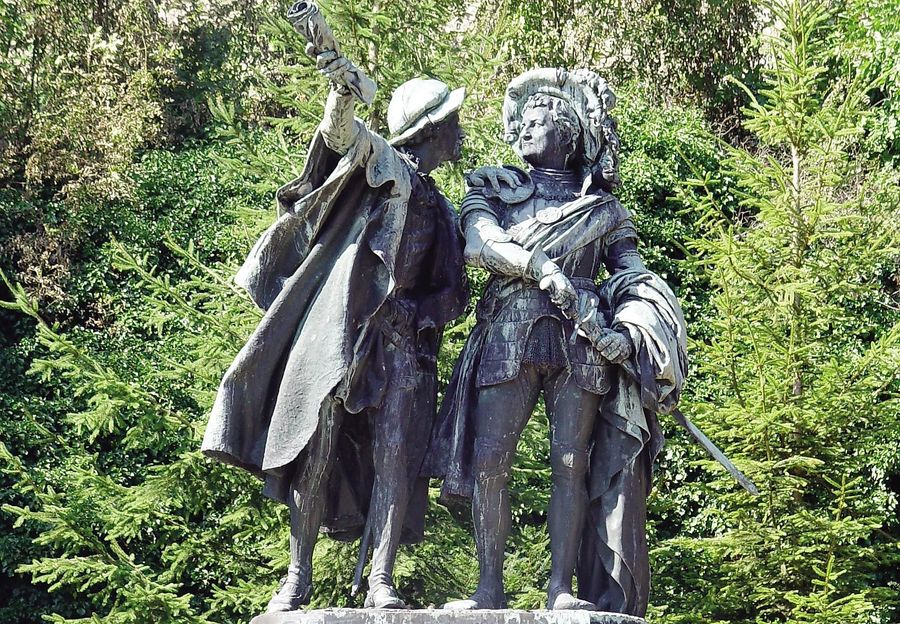
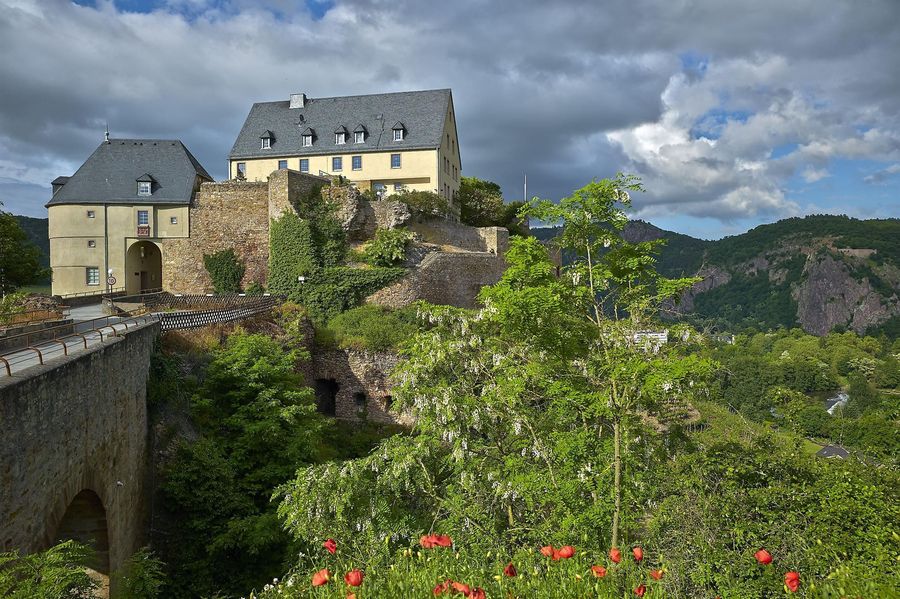
Those who reach Bad Münster am Stein-Ebernburg on the B 48 see before them the hill of Ebernburg, as it has been rebuilt since the 19th century. Upon a second glance, one discovers a group of figures halfway up. Cast in bronze are the knight Franz von Sickingen (1481-1523) and the poet Ulrich von Hutten (1488-1523), crowned with laurel by the emperor. Both represent a moment in world history when Ebernburg was at the center of events. In the early years of the Reformation, when Luther was excommunicated and his followers faced persecution, the mercenary leader Franz von Sickingen gathered around him a circle of theologians who were early supporters of Luther, such as Martin Bucer, Johannes Oekolampad, Kaspar Aquila, and Johannes Schwebel. However, particularly close to the knight, who can be described as a ruthless war entrepreneur, was Ulrich von Hutten. He was a widely known and highly esteemed humanist poet. With his propaganda against the “priestly rule,” against the papacy, and especially the financial exploitation of the German territories, he provided Sickingen with arguments for his actions, should he need them. Furthermore, he was suffering from syphilis and used the mercury mined in the region for treatments. The five-meter-high monument on the granite base features the two life-sized figures. On the left, the poet points the listening knight in the right direction with a scroll. The knight has his hand on the sword but hesitates. The sculpture, crafted by Hugo and Ludwig Cauer based on designs by their father Carl Cauer in 1889, expresses a Protestant-Prussian, anti-Catholic motivated national sentiment, thus reflecting the spirit of the Kulturkampf. The inscription celebrates both as “Forerunners of German Unity and Greatness.” The praised ones perished in this conflict. Sickingen died in battle against a princely alliance he had challenged. Ebernburg was destroyed. Hutten succumbed to his severe illness on the island of Ufenau near Zurich.
Hutten-Sickingen Monument
The monument for Ulrich von Hutten and Franz von Sickingen is located in a picturesque setting...
Categories
Contact details
Email: info@ebernburg.de Website: http://www.bad-kreuznach-tourist.de
Opening hours
Monday: 06:00 - 21:00Tuesday: 06:00 - 21:00
Wednesday: 06:00 - 21:00
Thursday: 06:00 - 21:00
Friday: 06:00 - 21:00
Saturday: 06:00 - 21:00
Sunday: 06:00 - 21:00
Address
Burg Ebernburg
55583
Bad Kreuznach
(DE)
Coordinates
Lat: 49.807472
Long: 7.838947
More information
The Mercenary Leader and the Poet – Glory and Downfall of Ebernburg
The Hutten-Sickingen Monument
Whoever reaches Ebernburg on B 48 Bad Münster am Stein sees before them the castle hill of Ebernburg, as it has been rebuilt since the 19th century. Upon a second glance, one discovers a group of figures halfway up. Cast in bronze are the knight Franz von Sickingen (1481-1523) and the poet Ulrich von Hutten (1488-1523), crowned by the emperor with the laurel of poets. Both represent a moment in world history when Ebernburg was at the center of events. In the early years of the Reformation movement, when Luther was under the ban and his followers faced persecution, the mercenary leader Franz von Sickingen gathered around him a circle of theologians who were early supporters of Luther. Among them were Martin Bucer, Johannes Oekolampad, Kaspar Aquila, and Johannes Schwebel. However, particularly close to the knight, who can be described as a ruthless war entrepreneur, was Ulrich von Hutten. He was a widely known and highly esteemed humanist poet. With his propaganda against the “priestly rule,” against the papacy, and especially the financial exploitation of the German territories, he provided Sickingen with the arguments for his actions, should he need them. Furthermore, he was afflicted with syphilis and used the mercury mined in the region for treatments. The five-meter-high monument on the granite base features the two life-sized figures. On the left, the poet points the listening knight the way with the scroll. The knight has his hand on the sword, but he hesitates. The sculpture, made by Hugo and Ludwig Cauer based on designs by their father Carl Cauer in 1889, expresses a Protestant-Prussian, anti-Catholic motivated national sentiment, thus reflecting the spirit of the culture struggle. The inscription celebrates both as “Pioneers of German Unity and Greatness.” Those praised have perished in this conflict. Sickingen died in battle against a princely alliance he had challenged. Ebernburg was destroyed. Hutten succumbed to his severe suffering on the island of Ufenau near Zurich.
The monument for Ulrich von Hutten and Franz von Sickingen is located in a picturesque setting on the castle hill of Ebernburg. It commemorates that the knight Franz von Sickingen gathered opponents of the Roman Catholic Church around him at Ebernburg in the years 1520-22 including the humanistic writer and poet Ulrich von Hutten.