


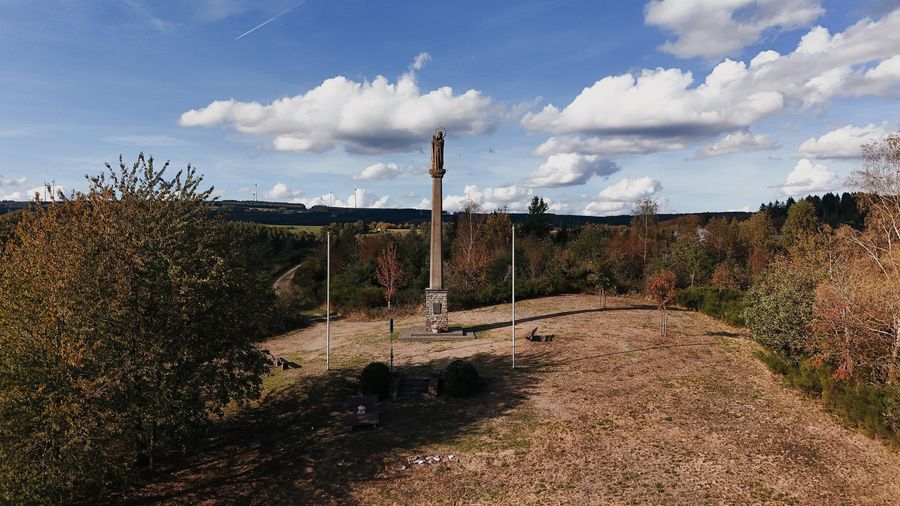
In the Marian Year 1954, the village community of Rapperath, inspired by Father Josef Gellenberg, built the 11-meter-high Mary's Column that towers over our village. Sculptor Rudolf Höfle from Morbach created the Madonna from Kordeler sandstone. Valentin Burkert not only forged the star crown of the Madonna but also contributed significantly to the successful completion of the structure with his pronounced technical understanding. A year later, the Stations of the Cross were created, leading from the "Great Lord God" to the Mary's Column.
The most important landmark of Rapperath is the Mary's Column
High above Rappenrath, the 11-meter-high Mary's Column was built in 1954. The Madonna is made of Kordeler sandstone and was created by the Morbach sculptor Rudolf Höfle.
Northwest of Morbach, an eleven-meter-high Mary's Column stands in the middle of the forest. It looks down on the district of Rapperath. Many locals helped in 1954 when the column was erected in the difficult terrain of the forest within four months. Klemens Müller is one who witnessed how vast amounts of gravel and concrete were processed for this quite monumental structure. Since then, the Mary's Column has been the destination of the annual pilgrimage that takes place on the Feast of the Assumption. Another important date in the local history is Easter Sunday. On this day, another Rapperath procession still takes place in the village. It leads to the "Great Lord God" – a life-sized representation of the crucified. The wooden cross is said to have been carved from a single piece by a carpenter from Hunsrück. Originally, this pilgrimage was intended to spare the locals from the impending cattle plague in the 18th century.
When Father Josef Gellenberg returned home from India in 1953 after 15 years of missionary work, Pope Pius XII announced a Marian Year for 1954. Inspired by Gellenberg's missionary zeal, a devotion to Mary developed, culminating in the decision to erect a Mary's Column. A benefactor was found for the Madonna. Sculptor Höfle from Morbach received the commission. He created a 2.80 m high statue of Mary from Kordeler sandstone, and Valentin Burkert forged the star crown. Thanks to the determined community spirit of the village population, the 11 m high concrete column could be inaugurated on schedule on August 15, 1954.
Mary's Column
The most important landmark of Rapperath is the Mary's Column
Categories
Contact details
Email: touristinfo@morbach.de Phone: (0049)6533 71-117 Website: http://morbach.de
Opening hours
Monday: 00:00 - 23:59Tuesday: 00:00 - 23:59
Wednesday: 00:00 - 23:59
Thursday: 00:00 - 23:59
Friday: 00:00 - 23:59
Saturday: 00:00 - 23:59
Sunday: 00:00 - 23:59
Address
Bahnhofstraße 19
54497
Morbach
(DE)
Coordinates
Lat: 49.819060
Long: 7.096979
More information
The most important landmark of Rapperath is the Marian column
In the Marian year 1954, the village community of Rapperath, under the encouragement of Father Josef Gellenberg, built the 11-meter-high Marian column that towers over our village. Sculptor Rudolf Höfle from Morbach created the Madonna from Kordeler sandstone. Valentin Burkert not only forged the crown of stars for the Madonna but also contributed significantly to the successful completion of the structure with his pronounced technical understanding. A year later, the Stations of the Cross were created, leading from the "Great Lord" to the Marian column.
The most important landmark of Rapperath is the Marian column
High above Rappenrath, the 11-meter-high Marian column was built in 1954. The Madonna is made of Kordeler sandstone and was created by the Morbach sculptor Rudolf Höfle.
Northwest of Morbach, an eleven-meter-high Marian column stands in the middle of the forest. It looks down on the district of Rapperath. Many locals helped in 1954 when the column was erected in the difficult terrain of the forest within four months. Klemens Müller is one who witnessed how vast amounts of gravel and concrete were processed for this quite monumental structure. Since then, the Marian column has been the destination of the annual pilgrimage that takes place on the Feast of the Assumption. Another important date in the local history is Easter Sunday. On this day, another Rapperath procession still takes place in the village. It leads to the "Great Lord" – a life-sized representation of the crucified. The wooden cross is said to have been carved from a single piece by a carpenter from Hunsrück. Originally, this pilgrimage was intended to spare the locals from the impending cattle plague in the 18th century.
When Father Josef Gellenberg returned home from India in 1953 after 15 years of missionary work, Pope Pius XII announced a Marian year for 1954. Inspired by Gellenberg's missionary zeal, a devotion to Mary developed, culminating in the decision to erect a Marian column. A benefactor was found for the Madonna. Sculptor Höfle from Morbach received the commission. He created a 2.80 m high statue of Mary from Kordeler sandstone, and Valentin Burkert forged the crown of stars. Thanks to the determined community spirit of the village population, the 11 m high concrete column could be inaugurated on schedule on August 15, 1954.