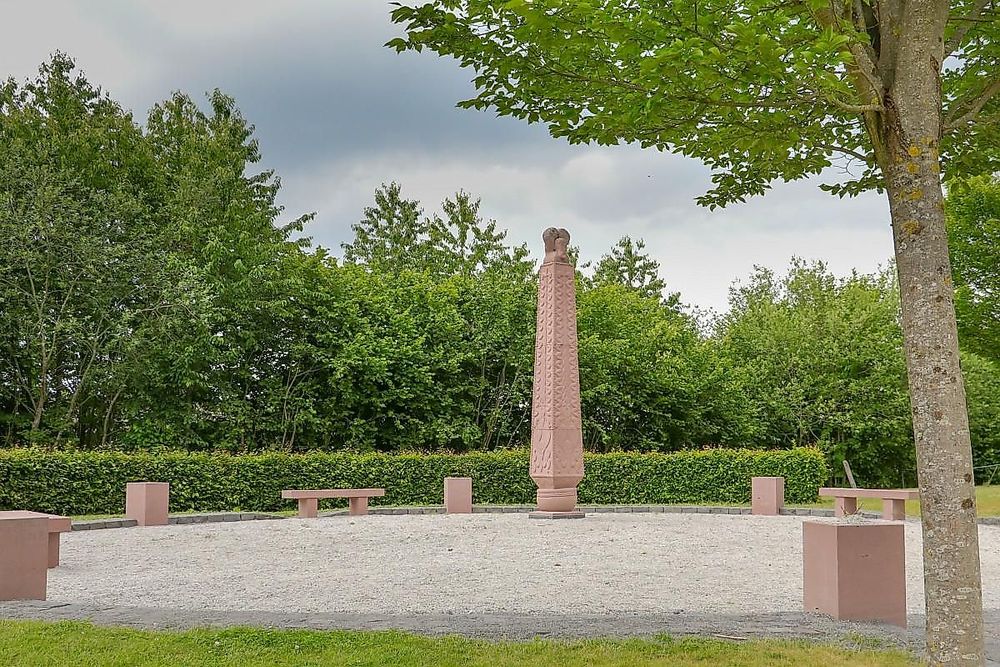
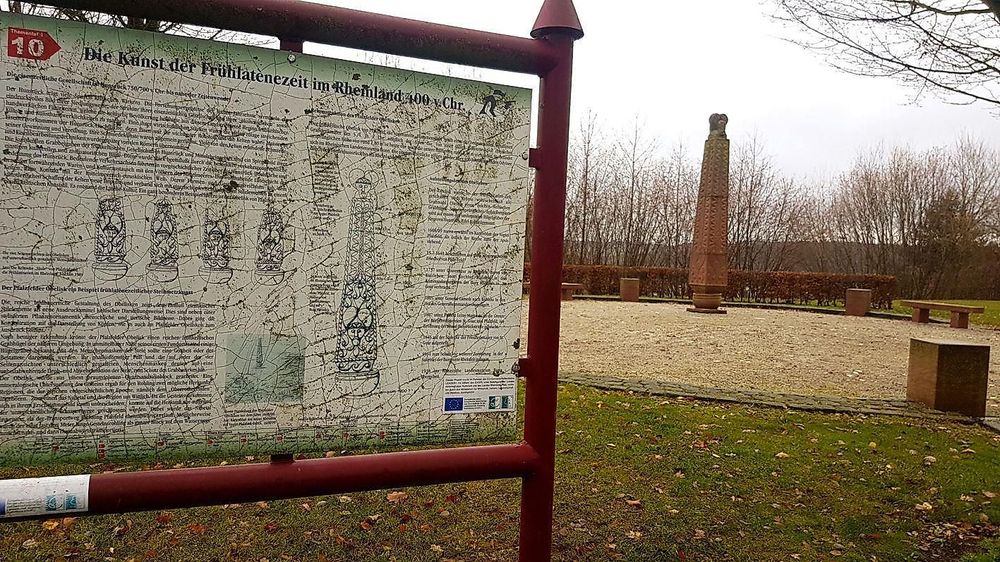
The Pfalzfeld Column (also Flame Column) is a Celtic stele made of sandstone, which presumably originally served as a cult column on a burial mound. It is attributed to the La Tène period and was created in the 4th century BC. Near the find site of Pfalzfeld (Hunsrück), some burial mounds are known, but a precise assignment can no longer be made.
Only the lower part, 1.48 m high, of an originally probably about 3.50 m high stele made from a sandstone block has been preserved. In the middle field, there is a mask-like human head with large eyes, which bears a triple leaf on the forehead, eyebrows, and a horizontal band, as well as a so-called palmette beard, which, as a similar statue from Glauberg suggests, could be the stylized decorative pendant of a neck ring (torques). The head is topped by two bubble-shaped parts of a Celtic leaf crown. Perhaps they represent mistletoe leaves. The sacred mistletoe was believed to heal all diseases and remedy infertility in humans and animals. It thus strengthened all life and growth forces. This form of mistletoe leaves is also found on the handle figure of the jug from Waldalgesheim. The head thus occupies a prominent position on the column and shows the special significance of the human head among the Celts: for them, the head was the center of being.
Historical illustrations and descriptions suggest that the stele probably had another (fully plastic and double?) head representation at the upper end and sat on a round shaft.
The Pfalzfeld Column likely served as a crowning element of a burial mound. With its four decorated, plastic sides, it is one of the most important examples of early Celtic art. The braid, spiral, and mask representations, as well as the connection of human face and phallic form, show connections to the North Italian-Etruscan area and had a protective and warding-off character for the socially high-ranking deceased.