


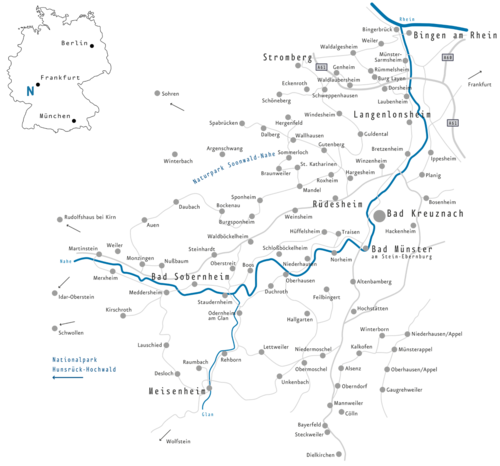
The Nahe has its origin in Saarland, not far from Lake Bostal, and meanders for about 120 kilometers through a varied landscape before flowing into the Rhine at Bingen. Along its way, it forms the natural border between the Hunsrück and the Northern Palatinate Uplands, overcoming some elevation changes.
The Nahe Wine
With its five tributaries, the Nahe shapes the region like a living network and provides ideal conditions for viticulture. The unique interplay of river, climate, and landscape gives this area its special charm and makes it one of the most exciting wine regions in Germany.
Small but of Special Quality
The Nahe wine region covers an area of more than 4,200 hectares. Our vineyards are located in gentle hilly landscapes as well as on sun-drenched steep slopes, providing ideal conditions for viticulture.
Along the Nahe – from Martinstein to its confluence with the Rhine at Bingen – the vines shape the landscape. The valleys of the tributaries such as Ellerbach, Guldenbach, Gräfenbach, Glan, and Alsenz are also characterized by viticulture.
The climate in the Nahe is considered balanced, rather mild, and comparatively dry. In the lower-lying areas between Bingen and Bad Kreuznach, particularly Pinot varieties and heat-loving red grape varieties find optimal conditions. Here, wines with high ripeness and balanced acidity are produced.
Further upstream and in the side valleys, cooler air currents from the surrounding low mountain ranges influence the climate. This extends the ripening period of the grapes, which has a particularly positive effect on the aroma and freshness of Riesling wines. The result is elegant, lively, and fruit-driven wines.
The Nahe is characterized by a great diversity of grape varieties, with white varieties accounting for about three-quarters of the cultivated area. The most important include Riesling, Müller-Thurgau, and Grauburgunder. At the same time, aromatic varieties such as Sauvignon Blanc and Scheurebe are gaining in importance. In the red wine sector, Dornfelder dominates, followed by Spätburgunder, Regent, and Portugieser.
A large portion of the produced wines is marketed as quality wine or predicate wine. Many wineries also focus on direct sales – about half of the products are sold directly to customers without intermediaries. In total, around 350 businesses are active in the region.