


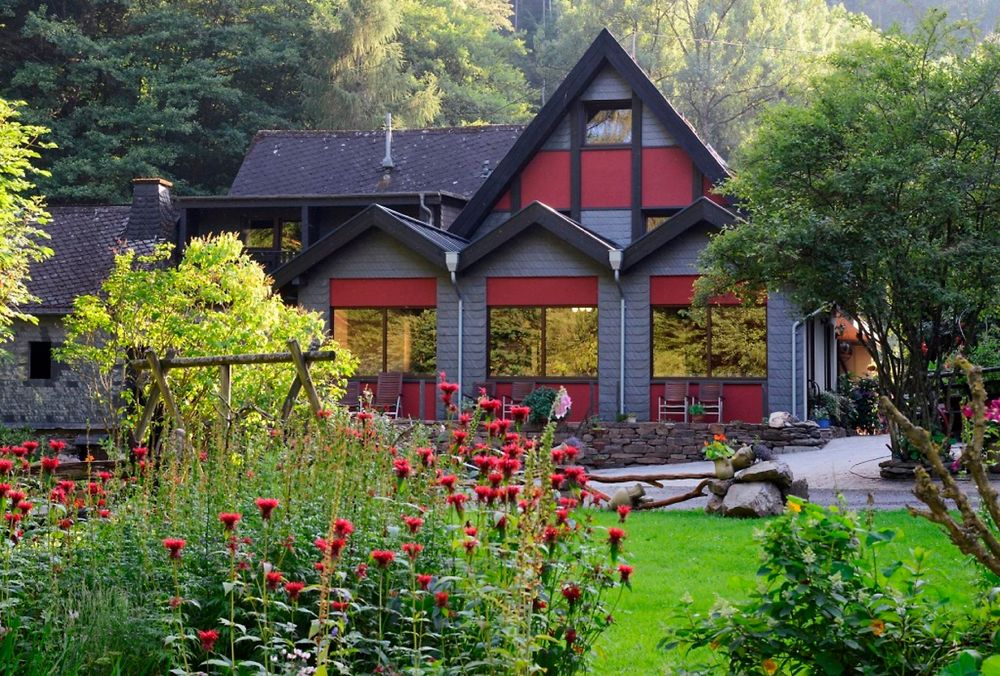
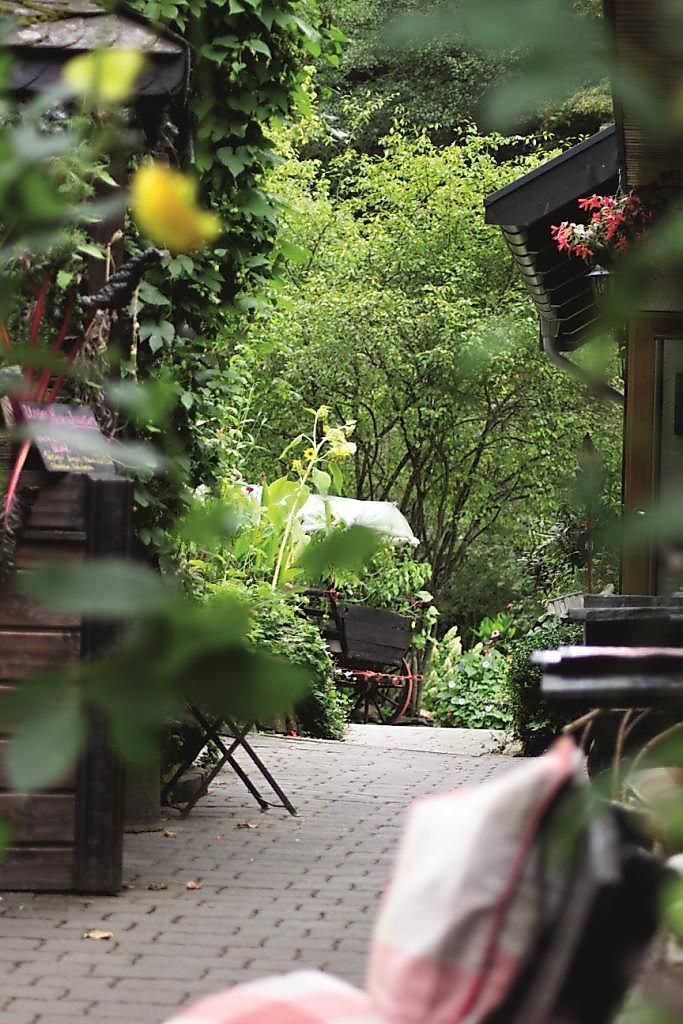
The valley widens, and we pass a horse paddock where a four-legged friend shows off its jumping skills. Well-maintained fish ponds come into view, and then we see our "destination" ahead of us, the Schmausemühle. Here we want to take our well-deserved lunch break. And since we saw the fish ponds earlier, we let ourselves be served freshly caught and prepared trout, which taste excellent.
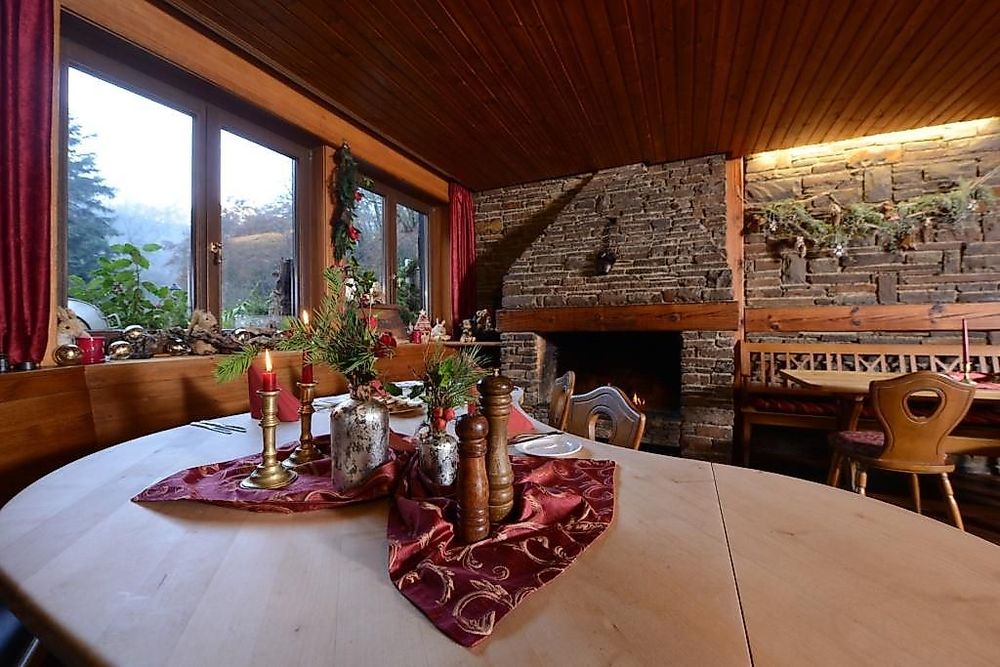
The Schmausemühle can be considered a kind of center of the valley. Not only have we now covered about half of our hiking route, but there is also a junction from one side of the valley to the other. Both from the southern direction of Sevenich - Heyweiler and from the north from Gondershausen - Beulich, access roads lead into the valley, meeting at the Schmausemühle. The road from Gondershausen even received an asphalt surface in 2000. The owners, who have been living in the mill for eight generations now, have turned their house into a popular and frequently visited excursion and holiday destination where vacationers find peace and relaxation.
The history of the mill can be traced back about 350 years, to the time of the Thirty Years' War. It changed its name several times and was called Scheid-, Pies-, Pinger-, and finally Schmausemühle after its owners. The operation of its mill ran well, and they had customers far beyond the immediate vicinity. Several horses were kept in the mill, which they used to collect grain from the farmers and bring back flour. Life in the mill was hard; in addition to the milling operation, they also maintained a farm. There were always long journeys to the fields on the Gondershausen heights. The stream itself sometimes caused trouble for the millers.
Rudi Liesenfeld, who has retired, remembers a terrible flood in January 1918. The Bay swelled mightily and flooded the entire mill property. The livestock in the barn was already standing in water and could only be saved with great difficulty.
Even in the Schmausemühle, a story about Schinderhannes is told. At the end of the 18th century, when the French revolutionary troops invaded the Rhineland, he is said to have brought the last Countess of Manderscheid in the Eifel to safety in an adventurous way before the French. Her escape route into the inner German lands led her through the remote Baybachtal, and on an autumn evening, they knocked on the shutters of the Schmausemühle and asked for a place to stay for the night. The miller was very startled by the late visit but granted the refugees shelter and satisfied their hunger and thirst. Since the countess was very exhausted, they took a few days of rest in the hospitable mill, and there the millers learned the true identity of their guests. Upon departure, the countess pressed a bag of gold coins into the miller's hands as a thank you, and Schinderhannes issued him a safe conduct pass that protected him from the band of robbers.
Rejuvenated, we leave the Schmausemühle and set out on the second part of our hike with good spirits. After just a few minutes, we pass a romantic rocky gorge, where steep stone walls rise high on both sides of the stream. On the left is the Hohe Rabenley, which rises about 70 meters steeply and thus surpasses the already described rocky slopes. We find several more of these angular rock outcrops in the valley, including the Hexenlay, where a dark chapter of history took place in 1590. It was the time of the terrible witch hunts, and in the nearby village of Dorweiler, the beautiful maiden Brigitte was identified as a witch. She was accused of having enjoyed herself with the devil at night. She was said to have bewitched five young men and two priests. According to the protocol, she transformed into a wolf and bit 13 children to death. Many cows were said to have been enchanted by her, so they no longer gave milk. And so the trial against the "witch" took place, where the verdict was already predetermined. Brigitte was painfully burned at the Hexenley.
In the past, several slate quarries were operated in the Baybachtal; below the Schmausemühle, we still see spoil heaps and mine entrances that were driven several hundred meters into the mountain. There were still up to 40 workers employed there in 1921. At the earth outcrops, one can still recognize the massive slate plates that were folded out of the earth's interior millions of years ago.
At one of the slate quarries, which was located a bit uphill on the "Kraxelpfad" to Steffenshof, a tragic accident occurred on the night of January 12, 1862. The miner Jakob Valerius lived with his eight-member family in a small mining house that stood close to the rock wall. And that night, there was a severe rockslide that buried the small dwelling along with the sleeping family. Only the two oldest sons, aged 14 and 17, who were sleeping in a small room under the roof, could escape through the gable window. They ran to the nearby Schmausemühle to get help. The millers rushed to the scene, but their efforts were in vain - the parents and their four small children aged one, three, six, and eleven could only be recovered dead. Today, the remains of the destroyed house can still be seen at the accident site, although they are now almost overgrown with bushes, thorn hedges, and moss. The Hunsrück home poet Jakob Kneip from Morshausen poetically processed this tragic event in a story, albeit with a happy ending contrary to the actual course of events.
20. From Mill to Mill in the Baybachtal Schmausemühle
The Schmausemühle: The valley widens, and we pass a horse paddock where a...

Categories
Contact details
Phone: (0049) 6745270 Website: http://www.schmausemuehle.de
Opening hours
Monday: 00:00 - 23:59 UhrTuesday: 00:00 - 23:59 Uhr
Wednesday: 00:00 - 23:59 Uhr
Thursday: 00:00 - 23:59 Uhr
Friday: 00:00 - 23:59 Uhr
Saturday: 00:00 - 23:59 Uhr
Sunday: 00:00 - 23:59 Uhr
Address
56283 Gondershausen (DE)
Coordinates
Lat: 50.136860
Long: 7.454319