


The Waldecker Mill:
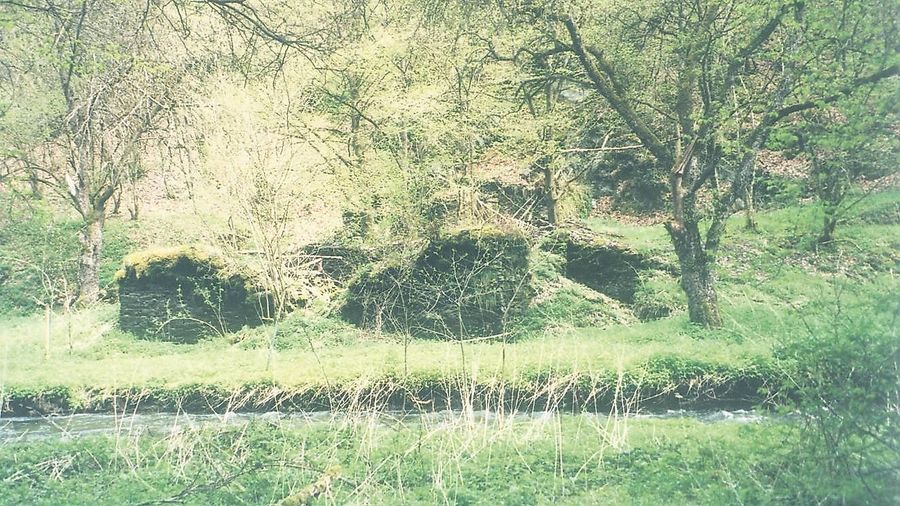
We have become contemplative about this terrible event, even though it happened almost 140 years ago. The next thing we discover on our path shows us the transience of all worldly things. On the right bank of the stream, in the district of Beulich, once stood the Waldecker Mill, of which only a few crumbling wall remnants can still be seen. It was one of the oldest mills in the entire valley. It is mentioned in a tax register of the Electorate of Trier from the year 1563, and at that time it was owned by the knight Jörg Boos von Waldeck, hence the name. In 1692, the Philipp Link family lived in the mill. However, the milling operation was already discontinued before 1900, and the mill was still inhabited until the mid-1920s, after which it fell into ruin.
In this section of the Baybach Trail, which winds through rugged rocks, we must overcome some difficult passages. Narrow paths lead over rocky cliffs, which are well secured by hand ropes. In this area, the rare wildcat and the kingfisher are said to be native. But it would be a stroke of luck to catch a glimpse of one of these animals.
Having passed the Waldecker Mill, it shouldn't be far to the well-known Waldeck Castle. We were right; after about 500 meters, the narrow valley opens up, revealing a wide gentle meadow before us, and then we see the ruins of Waldeck high up on the left.
A visit to this historically significant site is, of course, a must. However, we must climb a mountain path for about 20 minutes before entering the expansive castle complex through a high archway. We see crumbling bastions and walls. If they could talk, they would tell of a tumultuous history.
In fact, there were two castles that stood on Waldeck. The first structure, the "Upper Castle," was located on the height of what later became known as the "Dragon's Head." It is first documented in 1242 when the knights Heribert, Udo, Bosso, and Winand pledged their castle to the Archbishopric of Cologne in exchange for an annual rent of 12 loads of wine. The Upper Castle was not very large, so it was not sufficient as a residence for all the knightly families. Therefore, around 1250, the "Lower Castle" was built on the lower plateau. At times, 13 families lived in Waldeck. Their coexistence with the numerous servants was not always smooth. Several "peace treaties" were concluded, in which the rooms of the castle were precisely allocated. Even the use of the "restrooms" was strictly regulated.
The Waldecker family, especially the "red and black Booses," was very influential in the Rhineland. In 1331, they allied with the knights of Schöneck, Ehrenburg, and Eltz and even took on the powerful Elector of Trier, Baldwin. However, he tamed their arrogance in the famous "Eltzer Feud." In 1336, they had to submit to the Elector in a reconciliation treaty. In 1689, Waldeck, like so many other castles and towns, was completely destroyed by the French in the "Palatine War of Succession." In 1720, Baron Wilhelm Lothar Boos von Waldeck built a small baroque residence on the ruins, as was fashionable at the time. In the turmoil of the French occupation after 1800, the ownership of Waldeck changed hands, the little castle fell into disrepair, and was eventually sold for demolition. In the 1920s, new life awoke in Waldeck. The "Nerother Wandervögel" association bought part of the ruins and established their headquarters there. Under the leadership of brothers Robert and Karl Oel-bermann, the Nerother built their "Rhenish Youth Castle" at the historic site, which became a starting point for hikes and trips around the world. Another cultural movement also established itself around 1960 at Waldeck. For several years, folkloric festivals were held there, featuring today’s well-known songwriters, singers, and cabaret artists such as Reinhard Mey, Franz-Josef Degenhardt, Katja Ebstein, and Hans-Dieter Hüsch.
Still under the impression of the historical events that took place here, we stroll back down into the Bay Valley, where we follow the lively stream along a comfortable hiking trail.
21. From Mill to Mill in Baybachtal Waldecker Mill
The Waldecker Mill: On the right bank of the stream, in the district of Beulich, once stood the Waldecker...
Categories
Opening hours
The ruins are privately owned.
Address
56283 Beulich (DE)
Coordinates
Lat: 50.143093
Long: 7.443327