Below the village of Rapperath stands a massive arch bridge built of slate stones in the valley. The bridge crosses the Dhron, which here forms the boundary between the districts of Merscheid and Weiperath. It is the "Hammer Bridge." The name recalls a hammer mill that was established here over 200 years ago.
In 1773, the "Kurische Hofkammer zu Ehrenbreitstein" granted Wilhelm Diez, a miller from Gonzerath, permission to build a hammer and create a pond. It likely took several more years before the facility could be put into operation. When it was completed is not known, but the location can be precisely determined using official map material from 1829/30.
On March 11, 1790, the Stumm brothers, a company that made a name for itself primarily by purchasing existing mills and hammer works, auctioned the "New Hammer" near Weiperath, as documented by a court in "Morschied." A protocol from April 19 of the same year states that Wilhelm Diez had brought the Hammer Bridge into proper condition. A later receipt lists, among other things, the coal supplies taken over, meaning the iron hammer was already in operation before the auction. The hammer products were usually delivered to Abentheuer, the company's accounting location.
The hammer mill consisted of three water wheels, two fineries, and a large hammer; there may have also been one or two small hammers, which are not mentioned in the description but were common. The fineries were fanned by two bellows each. On the crankshafts, the shafts of the water wheels, there were pins and gears that facilitated the lifting of the hammers; the bellows were also driven this way. A large hammer weighed about 150 kilograms and made 60 - 80 strokes per minute, while a small hammer weighed about 35 - 40 kilograms and made around 200 strokes per minute.
In 1817/18, the iron hammer was shut down due to a lack of coal. The emergence of large iron and steel works with modern facilities eventually led to the closure of the smaller works. In 1822/23, the facility was sold, with only the residential house remaining occupied. It was a two-story stone house with a slate roof. Each floor had two "heated" rooms. In 1835, Friedrich Philipp Stumm bequeathed the hammer mill on the Dhron, among other things, to his three grandchildren, the Böcking brothers. In 1836 and in April 1841, the new owners acquired additional adjacent land, although the hammer mill as a workplace no longer existed. The total size of the property now amounted to about 2 hectares. In June 1841, the iron hammer was sold to a widow of a forester from Elzerath, who transferred it to her brother-in-law in 1848. Over time, however, the buildings fell into disrepair, and in 1856, the residential house was demolished. The stone ruins served the residents of the neighboring villages as a quarry. The remaining meadow was divided by its owner into 25 parcels, marketed, and subsequently sold.
Today, nothing remains of all the buildings; only the ditch is still partially preserved.
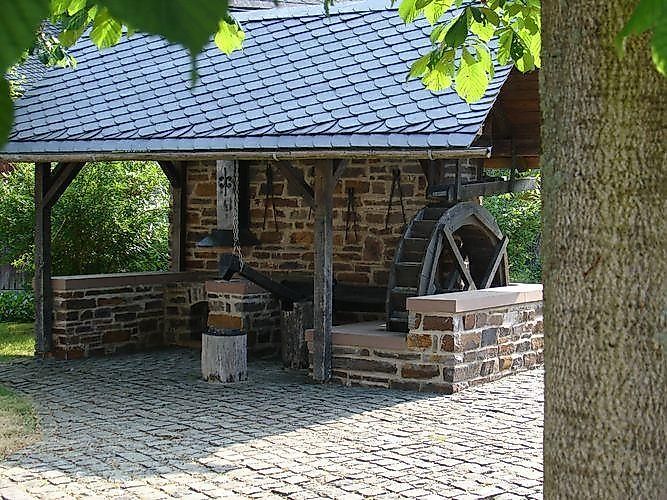
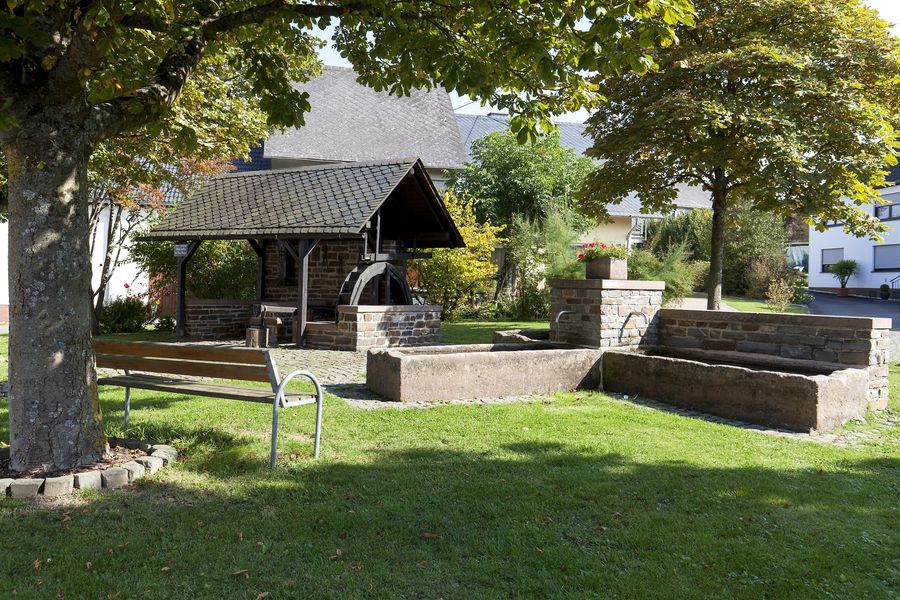
On the occasion of the 900th anniversary celebration of the village of Weiperath, an iron hammer was reconstructed. It stands in the village square near the well. It is fully functional, which is demonstrated on special occasions.
Source: "Weiperath - A Village and Its History"