


Evangelical Church Abtweiler
The name of Abtweiler, first mentioned in 1129, did not derive from 'Abbot', as the long-standing...
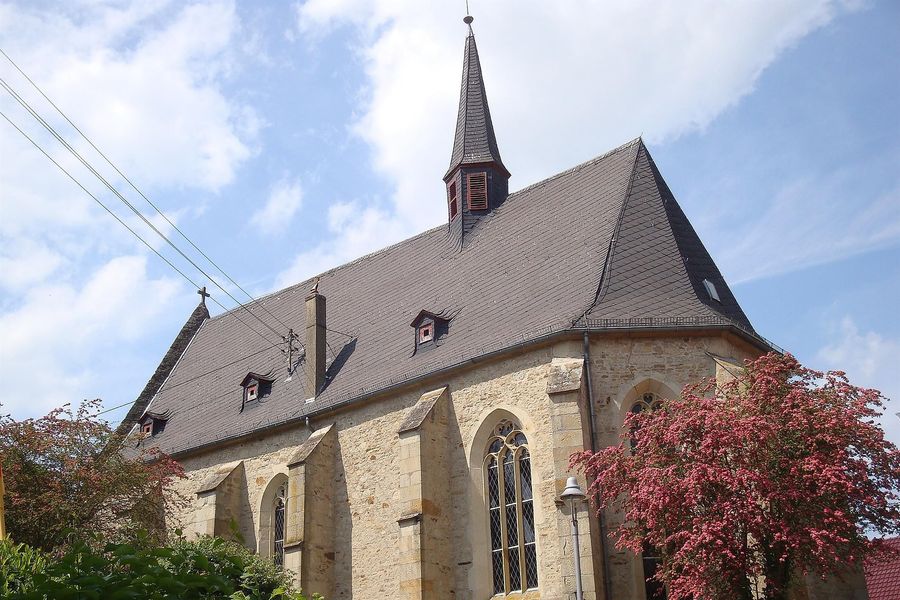
The name of Abtweiler, first mentioned in 1129, did not derive from 'Abbot', as the long-standing affiliation with the large parish of St. Nicholas on the Disibodenberg would suggest, but from 'apple', as evidenced by a court seal from the year 1711. The community likely emerged during the land expansion from Staudernheim, which is indicated not only by its geographical location, the shared rights of the Wild and Rheingrafen, and the affiliation with the same parish, but also by the shared forest ownership of Staudernheim, Abtweiler, and the later Hühnerhof. The revenues from this forest financed the construction of the first chapel in 1342. However, the current church is a work of late Gothic architecture, possibly designed in the first half of the 15th century by Heinrich Murer of Beckelnheym, who also worked on the church construction in Sobernheim. At that time, especially mendicant monks were active here. After the dissolution of the monastery on the Disibodenberg during the Reformation in 1560, church sovereignty passed to the former monastery bailiff, the Duke of Palatinate-Zweibrücken. Like Staudernheim, Abtweiler was assigned to the Palatinate-Zweibrücken parish of Odernheim. However, the Wild and Rheingrafen remained the feudal lords. In 1595, these overlapping competencies were resolved through an exchange of rights. In this process, the Count Palatine ceded the Staudernheim church, which became independent, along with the Abtweiler branch. The Reformed confession, which was mandated for the Duchy of Palatinate-Zweibrücken in 1588, likely did not gain a foothold in Abtweiler—if it was even introduced there—allowing the place to remain Lutheran. The Wild and Rheingrafen did not exercise authority in Abtweiler themselves but granted the place as a fief to knightly families. From 1604, the village belonged to the Barons of and to Steinkallenfels. In the 18th century, the church served as a burial place for the family. The ecclesiastical affiliation of the community changed, and it received its own parish only in 1704. Since 1815, however, it has belonged again to Staudernheim, which allowed for the unification of the two Protestant confessions in Abtweiler with the Meddersheim Union in 1818, unlike the other municipalities on the left bank of the Glan in the present association community. The church consists of the nave, the choir in the west, and the sacristy in the north. A bell tower with a pointed pyramid sits on the gable roof. Except for the south side, the church is supported by buttresses on all sides. Both the pointed arch portal and the two-part window above the stone cross of the gable are impressive. The nave consists of a simple hall with three ribbed vaults, while the five-sided choir, developed from an octagon, has a star vault. The keystones depict the head of Christ and a hand in a gesture of oath; the eastern crossing points are filled with masks, the southeasternmost of which may represent the master builder. In the southwest corner of the church interior, a round stair tower protrudes. Two wall paintings from the 15th century are noteworthy, one on the north side depicting the adoration of the Savior by the three wise men, and the other in the altar area showing the Holy Family. While the renewed pulpit made of red sandstone with a canopy likely dates from 1706, the pews were only made in 1925 by the carpentry shop Kehl from Staudernheim. The arrangement is remarkable: in the altar area, the benches are placed lengthwise, while in the back part of the church, they are arranged crosswise (interrupted by a central aisle). The organ on the gallery at the west side was built in 1857 by the famous Stumm brothers in Rhaunen-Sulzbach. After a somewhat unfortunate renovation, it is no longer visually a true Stumm organ, but it still retains its acoustic qualities. Of the bells, the oldest dates back to 1700 (two others were melted down during World War I). From 1940, it could no longer be used until the church community had it repaired in 1993 with great effort and commitment. The other two bells, cast in Bochum in 1924, were a gift from Jakob Baumann, who was born in Abtweiler but emigrated to America, and who also donated the red sandstone altar in 1960. The tombstones of six members of the family of the Barons of and to Steinkallenfels in the choir area are also of great significance. They consist of simple inscription plates adorned with ancestral coats of arms. Unfortunately, the informative inscriptions on the inside have already weathered significantly and require restoration. Among those buried in the church are Magdalena Salome von and zu Steinkallenfels, née Geyling von Altheim (1687-1719), her husband Karl Kasimir von and zu Steinkallenfels (1662-1722), the sisters Anna Magdalena (1669-1727) and Anna von and zu Steinkallenfels (1675-1736), the last Steinkallenfelser Philipp Heinrich (1714-1778), and a member of a collateral line, Karl von Holzhausen (+1779). Thus, only the last members of this lineage are interred here. A year before the first burial in Abtweiler, Juliane Magdalena von and zu Steinkallenfels, née Kötteritz (1642-1718), had herself buried in Meisenheim, where the family owned two noble estates, by the Lutheran pastor in the Reformed castle church. Apparently, the family did not want to depend on the goodwill of the Calvinist pastor in Meisenheim, who was very accommodating, so Abtweiler became the burial place. The Evangelical Church community is very committed to preserving this valuable house of worship and therefore commissioned a technical and art-historical renovation concept in the spring of 1996. Implementation has already begun, as the further decay was halted by applying a renovation plaster inside and outside. In the next step, restoration work (especially on the grave slabs) is to be carried out, for which support is still being sought. You can convince yourself that this project is worth the sweat of the noble by visiting!
Categories
Opening hours
Monday: 00:00 - 23:59 UhrTuesday: 00:00 - 23:59 Uhr
Wednesday: 00:00 - 23:59 Uhr
Thursday: 00:00 - 23:59 Uhr
Friday: 00:00 - 23:59 Uhr
Saturday: 00:00 - 23:59 Uhr
Sunday: 00:00 - 23:59 Uhr
Address
Hauptstraße
Abtweiler
(DE)
Coordinates
Lat: 49.744892
Long: 7.654724