


Evangelical Church Breitenheim
Breitenheim - known as "Breidenau" until the 18th century - has always belonged to the...
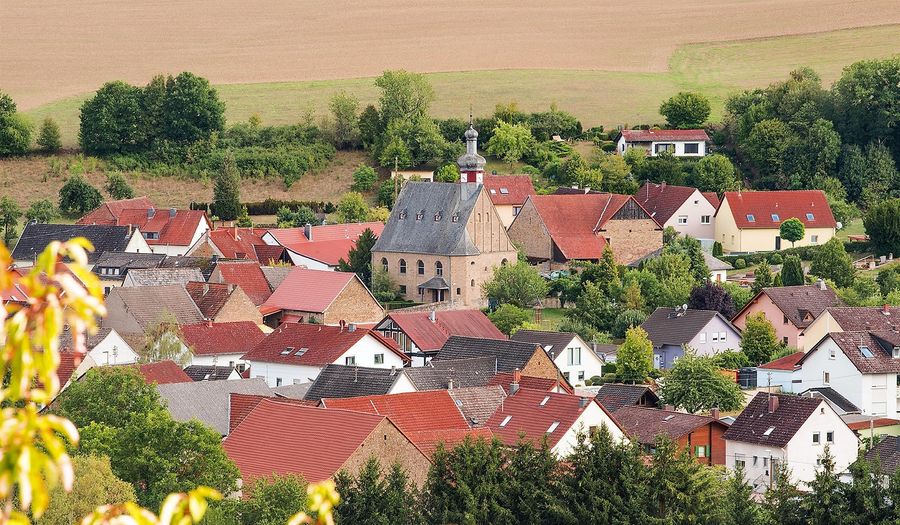
Breitenheim - known as "Breidenau" until the 18th century - has always belonged to the Veldenz district, later the Palatinate-Zweibrücken district of Meisenheim. The corresponding affiliation to the parish of Meisenheim outlasted the existence of the district: It was not until 1953 that the community became independent, although it was still served by Meisenheim until 1958, and since 1959 by Jeckenbach. In 1972, Breitenheim, Desloch, and Jeckenbach finally merged into a single church community. From the mid-15th century, a Johanniter chaplain from Meisenheim held mass in Breitenheim once a week. Naturally, the chapel shared many aspects of the fate of its mother church; thus, the Reformation was cautiously introduced from 1526 onwards; the so-called second Reformation, i.e., the transition to Calvinism, took place from 1588. At that time, the church foundation established in 1567 in Meisenheim was responsible for construction and maintenance and remained so until 1979 when the church passed into the possession of the Jeckenbach church community. For a transitional period after the dissolution of the Johanniter commandery in Meisenheim and the establishment of the church foundation, the church property was managed by two church masters under the supervision of the district mayor. The church accounts from these years (1535-1566) have been almost completely preserved. The Breitenheim chapel had to be handed over to the Catholics for the performance of ecclesiastical acts (baptism, marriage, burial) due to an edict from September 14, 1719, by the Catholic Duke Gustav Samuel Leopold, and was thus, like all daughter churches maintained by the church foundation of Meisenheim, a simultaneum. However, this likely did not have any practical effect, as there were hardly any Catholics in Breitenheim, and in 1757 there were none at all (about 87% of the Breitenheim population were Reformed, the rest Lutheran). The few Lutherans merged into the Protestant community due to the church union carried out in 1836 by the Hesse-Homburg district of Meisenheim. The present church is surrounded by a thick rubble stone wall and can be reached via an old staircase through a stone gate inscribed with Psalm 100. The house of worship consists of two parts: the late Gothic, undated choir, and the nave, which was only added in 1911/12 at the expense of the church foundation of Meisenheim under the direction of church builder Damm. Although today the original view that the distinctly ugly predecessor building was constructed in 1712 is rejected, this nave could not have been built together with the choir, as it did not match in proportions or style. It was probably added to the choir as a makeshift solution in difficult times. The image of the old church is captured in the stained glass window of the choir. The onion tower sitting on the roof is, despite its prominence, not a proper tower but a roof rider. It houses (electrically) a smaller bell, cast in 1898 in Kaiserslautern, and a larger one, cast in 1958 in Karlsruhe (two predecessors were melted down during the two world wars). The two-manual organ with nine registers was already installed in 1912 and has been fully restored in 1992. The late Gothic choir features tracery windows and buttresses. Inside, it is characterized by a beautiful ribbed vault. Additionally, a stonemason's mark and an unidentifiable human mask can still be seen. The oldest parts of the church visible from the outside date back to Roman times: On the choir buttress, a vine can be seen rising from a vase. More importantly, however, are the sandstone reliefs on the north side: They depict two mourning youths (Attis figures) and the bust of a dancer (apparently a Maenad from the entourage of the wine god Dionysus) with cymbals. These are remnants of a Roman tomb that were incorporated into the new construction in 1911/12. The Attis cult represented the hope for life after death (cf. the remarks on the Roman monument in Schweinschied). The church of Breitenheim is a successful example of how to harmoniously combine old and new. Don't miss this impression!
Categories
Contact details
Website: http://www.breitenheim.de
Opening hours
closed from 04.05.2021 to 04.05.2030
Address
Kirchstraße
55592
Breitenheim
(DE)
Coordinates
Lat: 49.697060
Long: 7.629147