


Evangelical Church of Desloch
Desloch has belonged to the parish of Meisenheim from the very beginning. When Count Georg I of Veldenz transferred the...
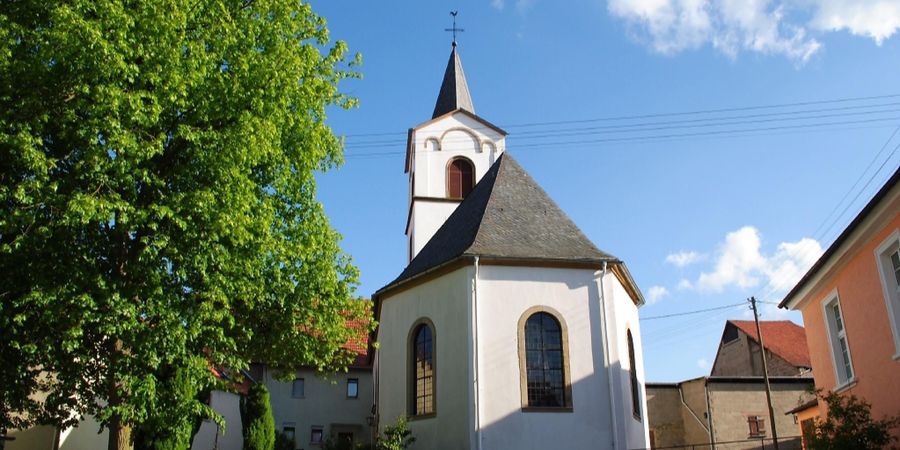
Desloch has belonged to the parish of Meisenheim from the very beginning. When Count Georg I of Veldenz transferred the Johannite church and parish of Meisenheim to the Knights Hospitaller in 1315, there was probably already a chapel in Desloch. The lower part of the tower is likely still medieval. Before the Johannites, monks from Disibodenberg may have held services in the community. After the introduction of the Reformation in Meisenheim starting in 1526 and the dissolution of the Johannite commandery, church sovereignty passed to the Duke of Palatinate-Zweibrücken. Meanwhile, the territorial sovereignty remained with the Wild- and Rheingrafen. As part of an exchange of rights aimed at eliminating such overlaps of authority, which contradicted the emerging idea of a closed territorial state, Desloch came to Palatinate-Zweibrücken in 1595. This was all the more necessary as the church-political Duke of Palatinate-Zweibrücken introduced Calvinism into his territory starting in 1588, while the Wild- and Rheingraf, who, like all territorial lords, was allowed to determine the confession of his subjects after the Augsburg Peace of 1555, remained Lutheran. Paradoxically, the old ecclesiastical connection to Meisenheim was dissolved, and Desloch was assigned to Hundsbach, even though it administratively belonged to the district of Meisenheim. Previously, the church council established in 1567 had been responsible for the construction obligations of the Desloch house of worship, as was the case for all churches or chapels of the parish of Meisenheim. The original chapel suffered severe damage in 1663 and 1697 due to the French. After it was demolished in 1747, the church in its current form was built by 1751. In confessional terms, significant changes had occurred in the preceding years: in 1720, there was a clear Reformed majority in Desloch (almost 56% compared to one-third Lutherans and just under 11% Catholics); however, by 1757, the Lutherans constituted the absolute majority of the population (about 63% compared to over 30% Reformed and approximately 6.5% Catholics) - a unique change in the district of Meisenheim! This did not happen without tensions; rather, there had even been violent confrontations (mainly over educational issues) between Lutherans and Reformed. Nevertheless, the Lutherans managed to establish a Simultaneum, allowing shared use of the new Reformed church. Finally, in 1836, the union of the two Protestant confessions was established throughout the now Hesse-Homburg district of Meisenheim - and thus also in Desloch. From 1839 to 1953, the community was again assigned to Meisenheim. In 1953, it became independent, but was still served by Meisenheim or, from 1959, by Jeckenbach. Since 1972, Desloch has belonged to the Jeckenbach parish, which in 1979 also received ownership of the Desloch church from the church council of Meisenheim. The church is a simple, three-aisled Baroque hall building, with a three-sided choir to the north and a massive tower, raised in 1857, to the south, whose lower part - as already mentioned - may date back to a medieval defensive tower. The tower houses two bells, one of which was cast in Zweibrücken in 1750 during the church's construction (the previous church had a bell from the Disibodenberg monastery, which may have been used to cast the new bell), while the other was manufactured in Bochum only in 1922. Unfortunately, due to renovations of the interior since 1959, a large part of the original furnishings (including the pulpit from the 18th century) has been lost. The impressive, but now unusable organ had to be replaced by a simple instrument from the company Oberlinger. The current interior design appears simple and modest. As a counterbalance, the church was adorned in 1980/81 with a contemporary artwork: the Italian artist Wilmo Gibello, living in England, completed the three striking stained glass windows of the choir, which were placed in front of the old round-arched windows, as well as the ten gold-framed picture panels hung in the interior, in just nine months (with the assistance of his student, the Spaniard F. Martinez). In an expressive symbolic language, the representations depict central passages from the Holy Scriptures. The artist, who had seen destroyed churches in Siberia, wanted to contribute to the glorification of God with his work (the house of worship in the image, which shows the completion of the church in the heavenly Jerusalem according to the Revelation of John, is clearly a Russian Orthodox church). Although the style of the individual images seems to shift between different directions, the artistic unity of the overall work is maintained. The hospitality of this charming house of God is already expressed by the fact that a pair of kestrels regularly nests in a window niche of the tower. Under the roof, however, the Grey Long-eared Bat, a species of bat threatened with extinction, has taken up residence for years. Contemplation, art, and nature - what more can one expect from a visit?
Categories
Opening hours
Monday: 00:00 - 23:59 UhrTuesday: 00:00 - 23:59 Uhr
Wednesday: 00:00 - 23:59 Uhr
Thursday: 00:00 - 23:59 Uhr
Friday: 00:00 - 23:59 Uhr
Saturday: 00:00 - 23:59 Uhr
Sunday: 00:00 - 23:59 Uhr
Address
Kirchgasse
Desloch
(DE)
Coordinates
Lat: 49.718708
Long: 7.629490