


Evangelical Church Jeckenbach
The chapel originally dedicated to Saint James in Jeckenbach can be attributed to the tower from the...
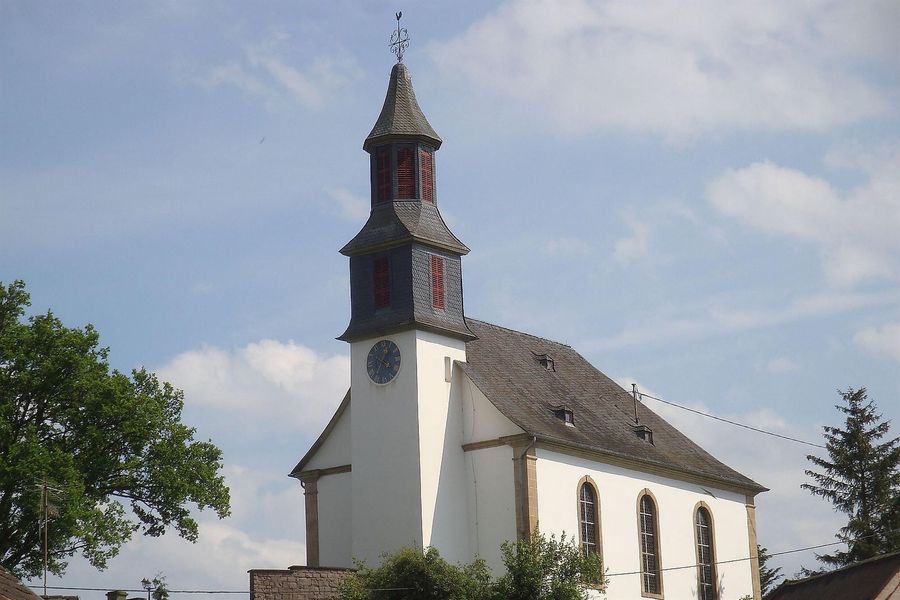
The chapel originally dedicated to Saint James in Jeckenbach can be attributed to the tower from the Romanesque building period. It already existed when Count Georg I of Veldenz transferred the church and parish of Meisenheim, to which Jeckenbach had belonged since time immemorial, to the Johannites in 1321. Before that, monks from Disibodenberg had provided pastoral care in the village. By the mid-15th century, the church had almost attained the status of a parish church, as mass was held here by order chaplains on Sundays and various holidays, and burials took place in the cemetery. However, by the end of the same century, the Johannites were increasingly overwhelmed by their pastoral duties and were represented in Jeckenbach by secular priests. After the introduction of the Reformation and the dissolution of the Johannite commandery in Meisenheim, the Duke of Palatinate-Zweibrücken became responsible for regulating church pastoral care, leading to the establishment of the Meisenheim church council in 1567. The ownership situation in the village was very convoluted. From 1382 to 1560, it was held as a wild and Rhine count's fief by many nobles until around 1560, when the Duke of Palatinate-Zweibrücken acquired the shares of the various owners through purchase. After 1588, the community of Jeckenbach adopted the Reformed faith and was incorporated into the parish of Hundsbach in 1596. In Jeckenbach, the chapel had to be made available to Catholics for occasional services (baptism, marriage, burial) due to the edict of the Catholic Duke Gustav Samuel Leopold from September 14, 1719, but this likely played a minor role in practice due to their small number; in 1757, for example, there were no Catholics in Jeckenbach (over 95% of the residents were Reformed, the rest Lutheran). The few Lutherans united in 1836 with the Reformed in the finally realized church union of the Hessian-Homburg district of Meisenheim. From 1839, Jeckenbach was pastorally cared for by the vice-principal of the Latin school in Meisenheim but returned to Hundsbach in 1863. In 1959, Jeckenbach became a parish, and in 1972, Breitenheim, Desloch, and Jeckenbach merged to form the Evangelical Church Community Jeckenbach, which in 1979 also took over the associated churches from the Meisenheim church council. The view of the village is shaped by the church, which is located in a charming elevated position amidst a cemetery. It consists of the tower and the church nave that adjoins it to the south. The tower dates back to the 12th century but was raised in 1767 during the reconstruction of the church nave. On the former bell chamber sits a square structure that supports an octagonal lantern with a truncated pyramid. Originally, bells from the Disibodenberg monastery rang from the church tower; the three bells today were cast in 1923 in Bockenem in the Harz. At the expense of the Meisenheim church council, the nave of the Reformed church was replaced in 1767 by a significantly larger one. The plans for this came from Philipp Heinrich Hellermann (1728-1806), the land building director from Palatinate-Zweibrücken, who was born in Meisenheim. It is a simple hall with three window axes and three round-arched windows. The interior shows a truly evangelical design. The altar and pulpit are arranged one above the other opposite the entrance, while there is a gallery on each of the two narrow sides. The northern gallery houses the organ, built in 1849 by the famous Stumm brothers from Rhaunen-Sulzbach, which is designed in a classicist style with baroque reminiscences. It has one manual and 17 registers. The interior of the baroque church possesses a rare value. To this day, the marbled fields of the balustrade have been spared from later overpainting. During the renovations of the 1960s, care was taken to restore the woodwork of the pews to its original condition. According to art historian Dr. Meinhold Lurz, the pulpit, gallery, and pews can be attributed to the famous artist and carpenter Georg Philipp Schmidt (1740-1816) from the Meisenheim Schmidt workshop. A visit is definitely worthwhile!
Categories
Opening hours
Monday: 00:00 - 23:59 UhrTuesday: 00:00 - 23:59 Uhr
Wednesday: 00:00 - 23:59 Uhr
Thursday: 00:00 - 23:59 Uhr
Friday: 00:00 - 23:59 Uhr
Saturday: 00:00 - 23:59 Uhr
Sunday: 00:00 - 23:59 Uhr
Address
Mühlstraße
Jeckenbach
(DE)
Coordinates
Lat: 49.708275
Long: 7.608376