


Evangelical Church Löllbach
The chapel of Löllbach belonged to the parish of Meisenheim, although the Wildgraves and not the Counts...
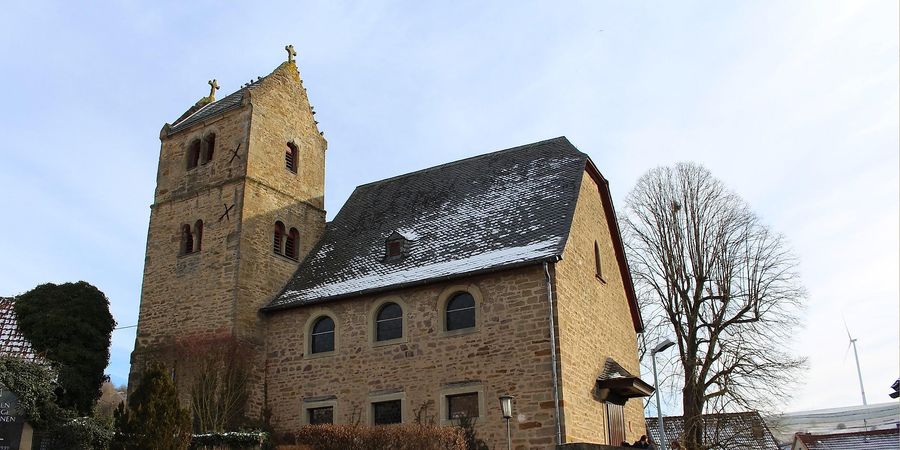
The chapel of Löllbach belonged to the parish of Meisenheim, although the Wildgraves, and not the Counts of Veldenz, were the landowners of the place. Like all chapels of the mentioned parish, it was cared for by the Johannites from 1321 onwards. After the dissolution of the Johannite Commandery in Meisenheim in 1531/32 as a result of the Reformation starting in 1526, the church political competencies lay with the Duke of Palatinate-Zweibrücken, who, however, ceded them to the Wild- and Rheingraves in 1595, so that the introduction of Calvinism in the duchy from 1588 likely had little effect in Löllbach. The church administration of Meisenheim (founded in 1567) was no longer responsible for the church. Löllbach was now the seat of its own Lutheran parish. In 1719, Catholics were granted joint use of the church. Finally, in 1836, the union with the Reformed was established. For some time now, Löllbach has been part of the parish of Hundsbach. The church is situated on a hill at the edge of the village amidst the walled former cemetery, which is now completely leveled. At the southwest corner of the church, the gravestone of the municipal mayor Johann Ludwig Meurer from the year 1742 is embedded in the wall. The tower, with its still recognizable sound holes, was built around 1200 in the northern corner between the choir and the nave. Its two lower floors are still Romanesque. When the late Gothic choir was built around 1500, the tower was raised by a third bell storey with a gable roof between masonry gables adorned with stone crosses. Three bells of different sizes hang there. The smallest was cast in 1864 in Neuwied. In contrast, the middle and large bells came to the Löllbach church from the Hamburg bell cemetery after World War II, in 1951. They originate from Breslau in Silesia (1685) and from Elbing in East Prussia (1687) as replacements for the two bells that had to be surrendered during the war. The church nave was destroyed in the Thirty Years' War and rebuilt around 1663. It was renewed once more in the 18th century. The rubble stone masonry is reinforced at the corners with blocks. The choir is very likely a work of Philipp von Gmünd, known as Hünermenger, the builder of the Meisenheim Castle Church and the Alexander Church in Zweibrücken. The choir is closed on three sides; the ceiling is a net vault, and the fish-bladder tracery windows are two-part. During the last restoration in 1967, the medieval choir painting was uncovered and renewed. When the church windows were renewed in 1963, the choir windows were artistically designed in color by Helmuth Uhrig. The middle window shows the risen Lord, the two lower ones depict "Risen from the Dead." The angel of God announces to the women: "The Lord lives, He has overcome death." In the two middle windows, it is depicted: "Ascended into Heaven." The messengers of God announce to the disciples: "He will return!" The other two windows illustrate parables: The parable of the great supper that is celebrated even when the initially invited guests decline; and the parable of the weeds that are separated from the wheat only at harvest time. The eleven paintings created by the painter Johann Engisch (1668-1742) are placed all around the gallery and on the west wall next to the entrance. They depict stories from the Old and New Testaments. Under each picture, the corresponding Bible verse is indicated, so that the viewer can read the depicted narratives based on these references. The paintings have only been hanging in their current place since their restoration in 1965. Previously, they were mounted in the choir area on the benches that were there at the time. The gallery, organ, and pulpit are made of wood and painted in muted colors of gray and red. The organ on the west side of the gallery was built in 1859 by the famous organ builders Gebrüder Stumm from Rhaunen-Sulzbach. It is a single-manual organ with 10 stops. The covered pulpit also comes from the Gebrüder Stumm and is harmoniously adapted to the architectural style of the entire building. The inscription on the upper and lower pulpit cornice in the style of the builders' time refers to biblical quotes (Isa. 58, verse 1 and Psalm 119, verse 105). On the underside of the pulpit canopy, there is an oil painting showing a dove with outstretched wings flying down from the clouds to proclaim "Peace be with you." The current seating, on the other hand, was only introduced into the church in 1967/68.
Categories
Opening hours
Monday: 00:00 - 23:59Tuesday: 00:00 - 23:59
Wednesday: 00:00 - 23:59
Thursday: 00:00 - 23:59
Friday: 00:00 - 23:59
Saturday: 00:00 - 23:59
Sunday: 00:00 - 23:59
Address
Oberdorf
Löllbach
(DE)
Coordinates
Lat: 49.684956
Long: 7.590866