Museum of the Disibodenberg Scivias Foundation

In parallel with the museum's opening hours, you can enjoy our beautiful museum courtyard or in...

Presumably, the Disibodenberg was already a place of cultic significance for the Celts and later for the Romans. The name Disibodenberg is derived from the Irish-Scottish wandering monk Disibod, who is considered the founding father of the monastery around 650.

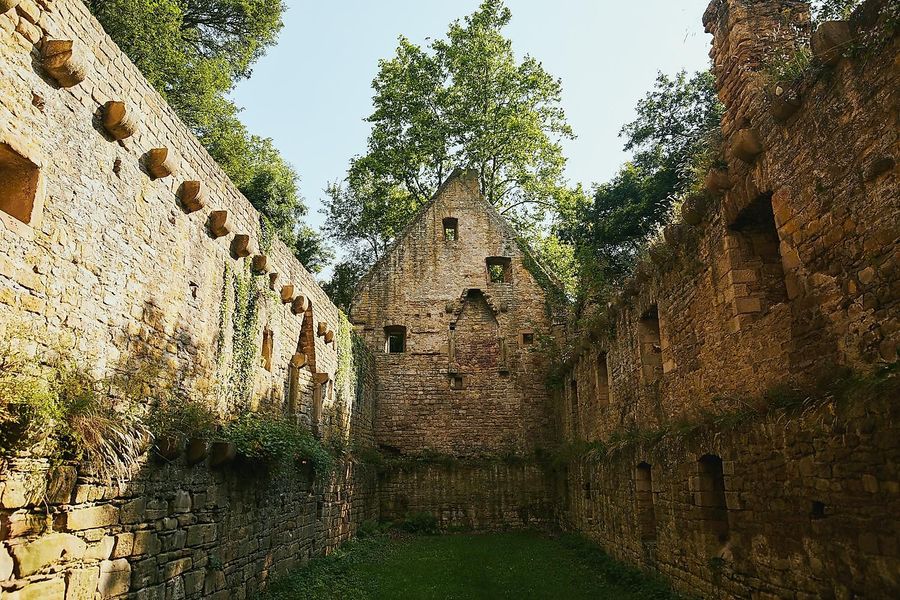
In the following period, the medieval monastery was expanded in several construction phases: Around 1000, Augustinians founded a chapter of canons on the Disibodenberg, and from 1100, Benedictines built a monastic complex with a basilica, three chapels, a cloister and garden, chapter house, sleeping quarters, kitchen, and workshops. This was the time when Hildegard of Bingen spent about 40 years in a hermitage on the Disibodenberg. From 1300, Cistercians added significant large buildings. However, after being abandoned by the monks in 1560, the monastery increasingly fell into disrepair and was used as a quarry by the surrounding communities. It was not until the privatization of the site in 1812 that this exploitation was halted.

Today, the complex is owned by the private Disibodenberg Scivias Foundation. Both the Disibodenberg monastery ruins and the integrated romantic landscape park from 1840 are protected as historical monuments and cover an area of 20,000 square meters. The archaeological museum displays stone witnesses from two millennia.
Categories

Exhibitions Holidays at home Art & Culture Museum
Opening hours
Monday: closed
Tuesday: closed
Wednesday: closed
Thursday: closed
Friday: closed
Saturday: 11:00 - 18:00
Sunday: 11:00 - 17:00
Address

Disibodenberger Hof 3
55571 Odernheim am Glan (DE)

Coordinates

Lat: 49.777985
Long: 7.703999

More information

Accessibility

The museum is located about 50 m from the parking lot and is accessible. Unfortunately, the mountain is not accessible for visits.

Parallel to the museum's opening hours, you can relax with us in the beautiful museum courtyard or in the archaeological museum with coffee, tea, and delicious cake.

Presumably, Disibodenberg was already a place of cultic significance for the Celts and later for the Romans. The name Disibodenberg is attributed to the Irish-Scottish wandering monk Disibod, who is considered the founding father of the monastery around 650.

In the following period, the medieval monastery was expanded in several construction phases: Around 1000, Augustinians founded a chapter house on Disibodenberg, and from 1100, Benedictines built a monastery complex with a basilica, three chapels, cloister and garden, chapter hall, sleeping quarters, kitchen, and workshops. This was the time when Hildegard of Bingen spent about 40 years in a hermitage on Disibodenberg. From 1300, Cistercians added significant large buildings. However, abandoned by the monks in 1560, the monastery gradually fell into disrepair and was used as a quarry by the surrounding communities. It was only with the privatization of the land starting in 1812 that this exploitation was stopped.

Today, the complex is owned by the private Disibodenberg Scivias Foundation. Both the Disibodenberg monastery ruins and the integrated romantic landscape park from 1840 are protected as historical monuments and cover an area of 20,000 square meters. The archaeological museum displays stone witnesses from two millennia.