


Protestant Church Reiffelbach
Between 1401 and 1441, a chapel "To the Holy Cross" must have been built in Reiffelbach.
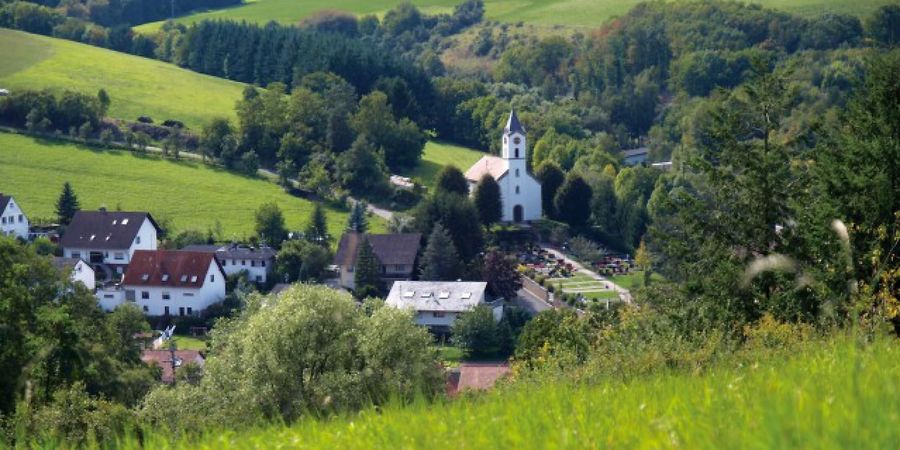
Between 1401 and 1441, a chapel "To the Holy Cross" must have been built in Reiffelbach. Reiffelbach - politically belonging to the Veldenz district, later the Palatinate-Zweibrücken district of Meisenheim - was pastorally cared for by the Johannites like all the communities of the parish of Meisenheim. This close connection also had an impact later during the introduction of the Reformation after 1526 and Calvinism after 1588. Reiffelbach was also affected by the Counter-Reformation during the conquest wars of Louis XIV: in 1684, the Franciscans performed the first baptisms. By this time, however, the chapel had long been in disrepair. It was not until 1721 that the new building was approved and completed in 1723. A bitter struggle for its use then ensued. While the Lutherans were not troubled by the Reformed, the latter tried to violently prevent the Catholics from performing the sacraments (baptism, marriage, burial) in the dilapidated old chapel. By 1757, over 55% of the Reiffelbach population was Reformed, a good quarter was Catholic, and just under a sixth was Lutheran. However, these confessional problems were a thing of the past when the construction of the current church was carried out in 1849 at the expense of the church council of Obermoschel (the predecessor building had already been auctioned for demolition in 1835). Reiffelbach belonged - as the boundary had severed the old connection to Meisenheim - to the (united in 1818) parish of Gangloff and was finally merged with it into Odenbach in 1975. The church is not located in the village but on a hill amidst a larger cemetery on the outskirts. The exterior is predominantly in the classical style. The tower is placed at the front of the church. During the renovation in 1962/63, it received a new crown. The interior was also designed very attractively. On one side of the nave, the gold-decorated gallery is supported by three stone columns, between which arches are located. The box-shaped altar is positioned directly opposite. It is made in a suitable natural wood frame construction. The pulpit is also made of natural wood. It has a canopy and is decorated in gold. The conversion that houses the organ from the company Oberlinger from Windesheim is also made of natural wood. A diverse correspondence regarding the bells has been preserved: Because the chapel had become dilapidated, the bells were removed from the tower and secured by the church warden in Meisenheim. After the French reintroduced the Catholic service in the Oberamt Meisenheim, they confiscated the two bells and assigned one to the Franciscan monastery in Meisenheim and the other to the Catholic chapel in Obermoschel with the promise to return both to Reiffelbach. Before the reconstruction of the chapel, the villagers therefore again approached the government (1717) and requested their return, especially since by then all three denominations would perform their sacraments in the church. At that time, it was evidently the bell hanging in the monastery in Meisenheim that was returned, while the Catholics in Obermoschel were not willing to hand over the one in their possession. In the meantime, a command for the return had been issued by the Palatinate-Zweibrücken bailiff Baron von Schorrenburg, which the Reiffelbach residents had evidently lost. They therefore resorted to self-help and, with the support of the church warden Philipp Nikolaus Wernher, attempted to forcibly retrieve their bell from Obermoschel. This action succeeded, but it did not sit well with the villagers. Three local citizens had to spend several days in the tower, and the church warden was replaced in 1721 "due to the foolishness of his mind" (initially temporarily) and lived in bitter poverty until his death. Additionally, the community had to pay a fine of 50 guilders and another 51 guilders for expenses. Of the two bells currently hanging in the church tower - which belong to the local community like the church clock - one is richly decorated. An inscription provides information about the manufacturer: "Cast by Joh. Georg Pfeifer, Kaiserslautern." It is adorned with a band of stars running around it. The ringing was consecrated in 1952.
Categories
Opening hours
Monday: 00:00 - 23:59 UhrTuesday: 00:00 - 23:59 Uhr
Wednesday: 00:00 - 23:59 Uhr
Thursday: 00:00 - 23:59 Uhr
Friday: 00:00 - 23:59 Uhr
Saturday: 00:00 - 23:59 Uhr
Sunday: 00:00 - 23:59 Uhr
Address
Friedhofstraße
Reiffelbach
(DE)
Coordinates
Lat: 49.688065
Long: 7.683563