


Protestant Church Schmittweiler
Via several stairs and an ascending path lined with birch trees, one reaches the...
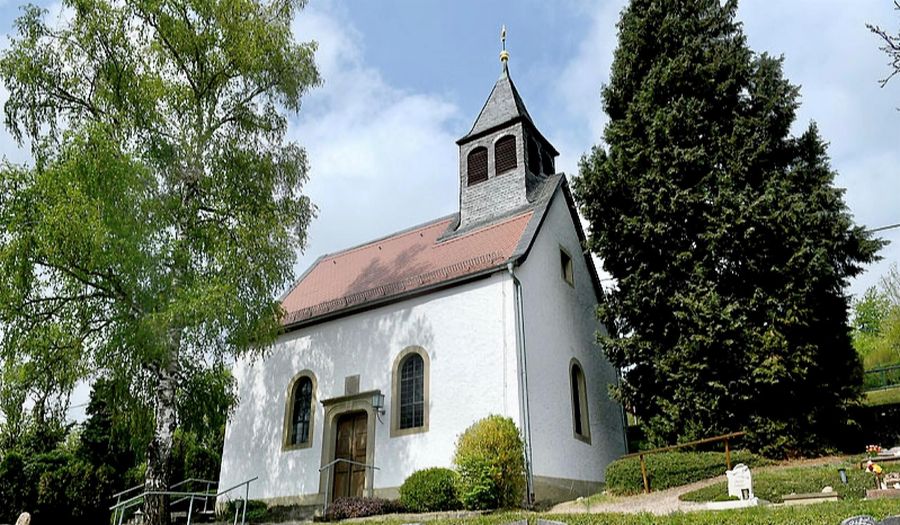
Via several stairs and an ascending path lined with birch trees, one reaches the small bright church in Schmittweiler, which is located in the midst of the cemetery. Schmittweiler, belonging to the Palatinate-Zweibrücken district and the parish of Meisenheim, received its own chapel only late - in 1749. This resulted in advantages and disadvantages: Unlike all other daughter churches of the parish of Meisenheim, the Catholics could not claim joint use, as the chapel did not exist at the time of the Treaty of Rijswijk in 1697 (by 1757, nearly 70% of Schmittweiler's inhabitants were Reformed, about 23% Catholic, and nearly 8% Lutheran). A disadvantage was that the church council of Meisenheim - which had only taken on older obligations - was not responsible for the construction. Thus, the Protestant residents of Schmittweiler of both denominations had no choice but to build their chapel in 1749 - as stated above the church entrance - by their own means. The central authorities in Zweibrücken apparently completely overlooked this development: When the Duke graciously approved the chapel construction in 1750, the Lutheran pastor and inspector in Meisenheim merely noted that the chapel had already been built and that the Lutherans were allowed to preach in it without opposition from the Reformed. The joint efforts for the chapel had apparently brought the two Protestant denominations in the village together and mitigated the usual oppositions, so the implementation of the Union in 1818 in Schmittweiler likely faced little opposition. The old connection to Meisenheim had already been severed by this time; Schmittweiler belonged for a long time (1806-1865) to Gangloff and, after several changes, came to the parish of Callbach in 1954. The church, renovated in 1962, is a small, almost square building. Three bells hang in the tower, of which the small bell is no longer functional. A hand rope is still mounted. The edge of the bell is broken in one place. It has the following inscription: "Paid for by the community of Schmittweiler. Georg Christoph Roth in Myntz cast me in 1747." A slightly higher bell in the tower is electrically operated. It was cast in 1963 in Karlsruhe. A third bell is placed next to the small, slightly higher-hanging one in the tower. The interior is made of light wood. A gallery is installed on two sides. The electronic organ is surrounded by a low wooden wall and stands in the middle of the church space. In the simple church, visitors are enveloped by an atmosphere of security and tranquility.
Categories
Opening hours
Monday: 00:00 - 23:59 UhrTuesday: 00:00 - 23:59 Uhr
Wednesday: 00:00 - 23:59 Uhr
Thursday: 00:00 - 23:59 Uhr
Friday: 00:00 - 23:59 Uhr
Saturday: 00:00 - 23:59 Uhr
Sunday: 00:00 - 23:59 Uhr
Address
Hauptstraße
Schmittweiler
(DE)
Coordinates
Lat: 49.691950
Long: 7.705021