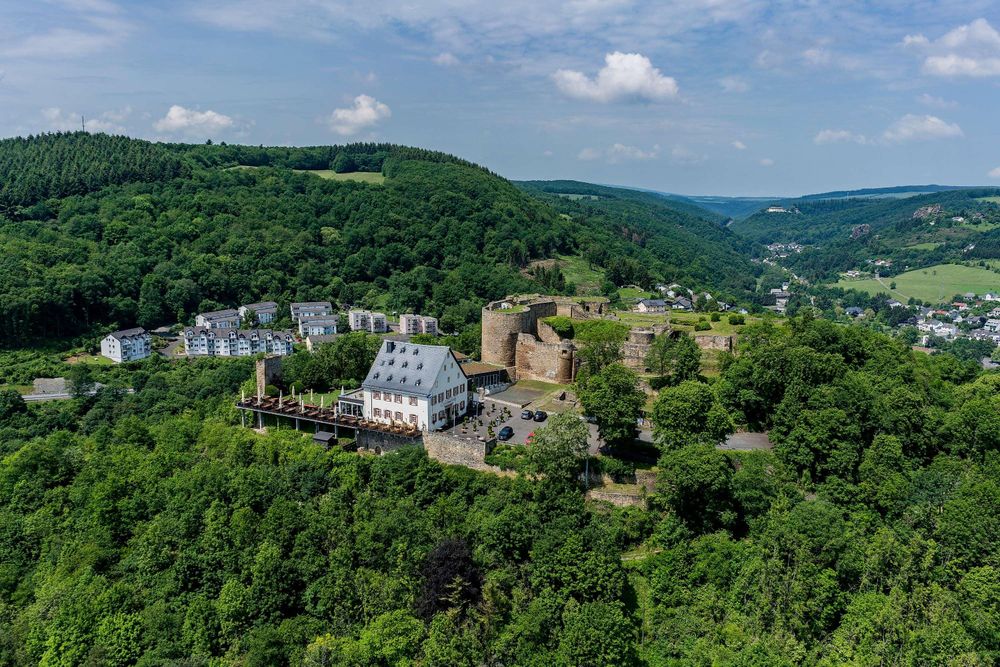
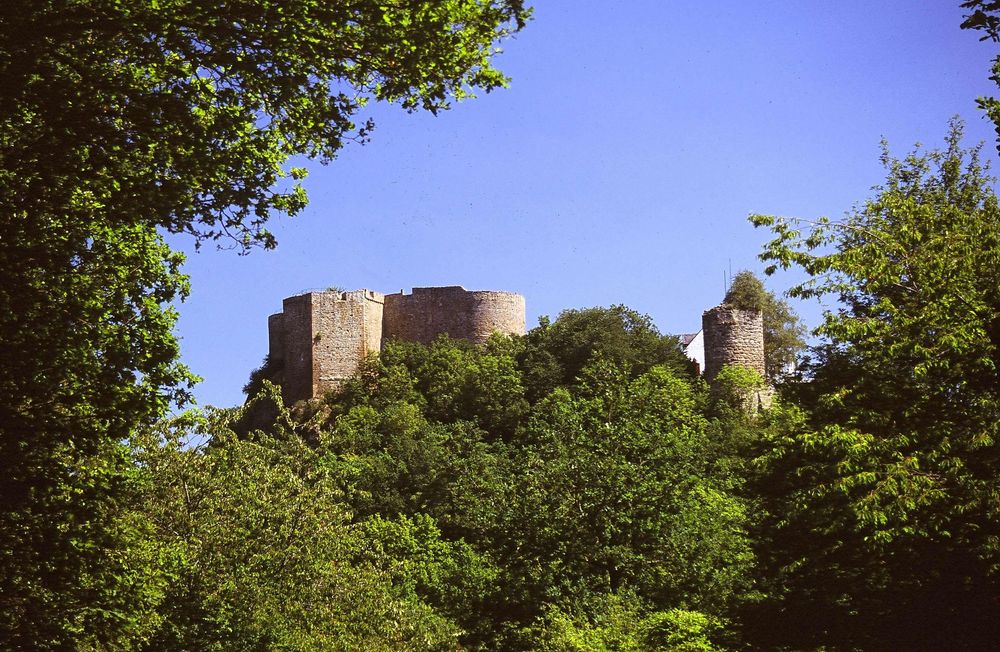
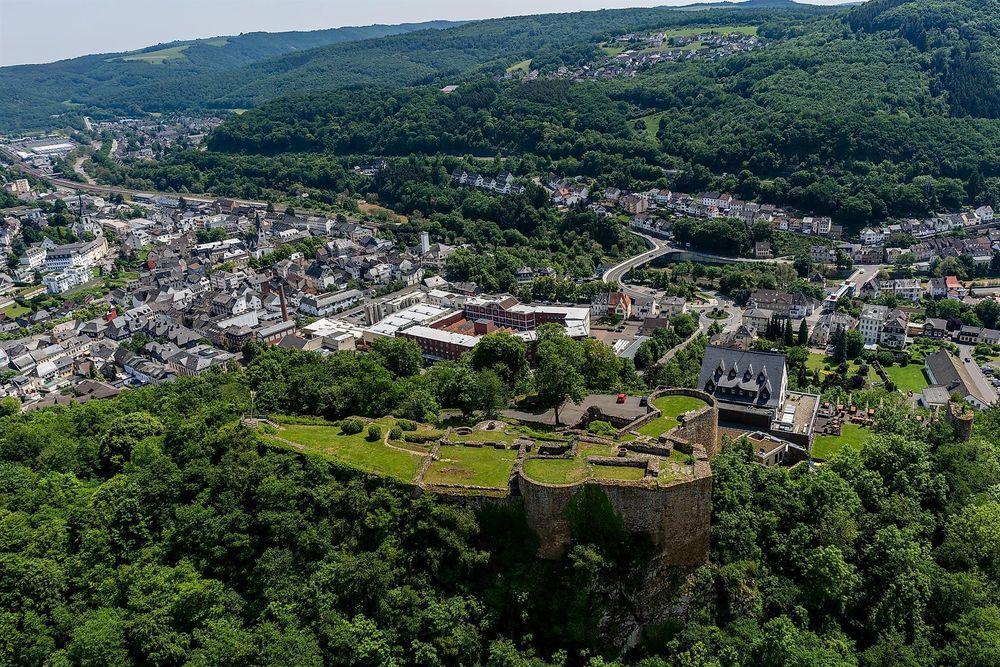
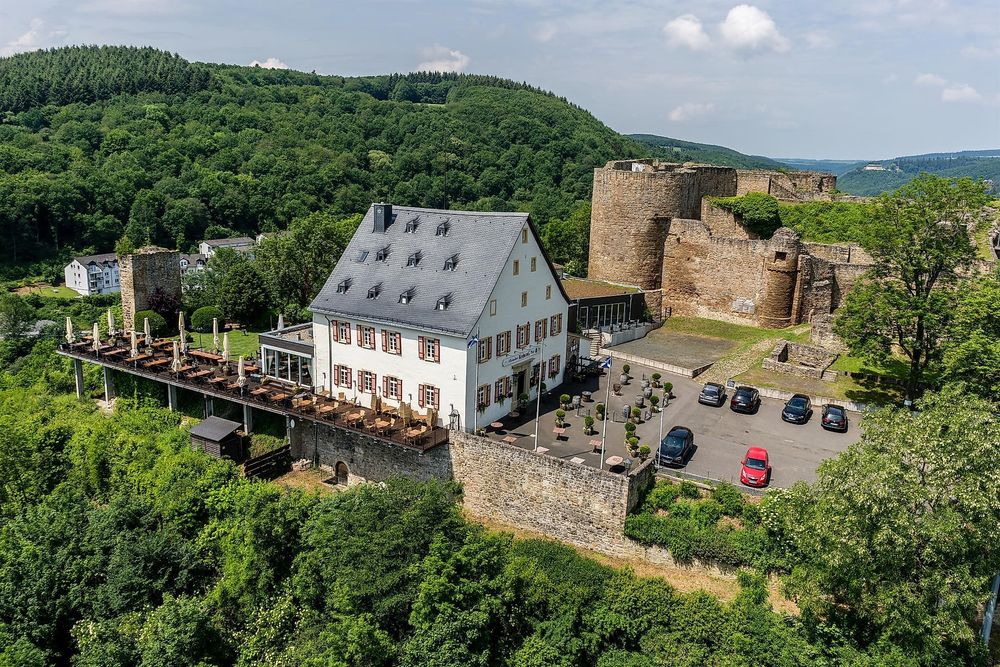
The landmark was built around the year 960 by the count Emicho. After a history marked by various occupations, the Kyrburg was destroyed by the French in 1734. In 1765, the surviving hay magazine was converted into a guardhouse, which today houses a restaurant. From the associated terrace, one can enjoy a magnificent view over Kirn and the Nahe Valley. In a deep cellar beneath the building, there is a whisky museum. The elaborately restored castle complex offers an impressive view over Kirn and the Nahe Valley from a high vantage point, extending to the southern heights of the Hunsrück. During the summer months, a restored vault is used as a wedding room for marriages.
The Kyrburg was a main castle of the Wildgrafen, whose ancestors are considered to be the Emichonen, appointed as Nahegaugrafen. The Kyrburg is first mentioned in a document from 1128 by Count "Emich de Kirberc" and his brother Gerlach. The Wildgrafen controlled significant passes from the Nahe to the Moselle from their castles Kyrburg, Schmidtburg, and Dhaun during the Middle Ages and shaped the political events in the Nahe and Hunsrück regions as holders of a "Landgrafschaft."
However, with the process of forming princely territorial lordships that began in the 13th century, there were conflicts with the archbishops and electors of Mainz (13th century) and Trier (14th century) over supremacy in this area. In the peace treaty of 1242, Wildgraf Konrad had to pledge the Kyrburg as a fief to the archbishopric of Mainz. Internal family and inheritance disputes subsequently led to a decline in the social and economic status of the wildgräflichen family, which lost the Schmidtburg to the Archbishop of Trier in the 14th century. The Wildgrafen became powers of secondary importance but managed to avoid complete absorption and maintain considerable independence through multiple vassalage to the archbishops of Mainz and Trier as well as the Palatine princes.
After the marriage of the heirs of the Rheingrafen into the Kyrburg line, there was a renewed rise of the wildgräflichen house in the 15th and 16th centuries. In 1743, the princes of Salm-Kyrburg inherited the legacy of the Wild- and Rheingrafen on Kyrburg.
The castle had a changing fate. During the Thirty Years' War, it was initially occupied by the Spaniards, then by the Swedes, and finally by imperial troops. By decision of the French reunification chambers, the French occupied the Kyrburg in 1681 and renewed its fortifications in 1689. After the Treaty of Rijswijk, the walls were demolished. In 1703, an imperial garrison repaired the damages. Under renewed French occupation, the fortress was finally blown up in 1734. A veto from the French king came too late.
In the ruins, Prince Johann Dominik had a two-story house built around 1764 to accommodate a small military unit (the current restaurant Kyrburg). After the conquest of the Nahe area by French revolutionary troops starting in 1794/1795, the principality of Salm-Kyrburg was initially declared neutral by the French commanders in 1797, but a year later was annexed by the French Republic.
As a so-called "national property," the castle was later auctioned by the postmaster Ludwig Medicus. Since 1908, the princely family Salm-Salm in Anholt/Westphalia has owned the Kyrburg, which was purchased by the city of Kirn in 1988. The archive of the former "Oberamt Kyrburg" is still located in Anholt.